Haringey Rhinos
White Hart Lane might be more famous as the home of a certain football team, but its one and only rugby club is making its mark, genuinely reflecting the diversity of the London borough, to stand out in the best possible way.
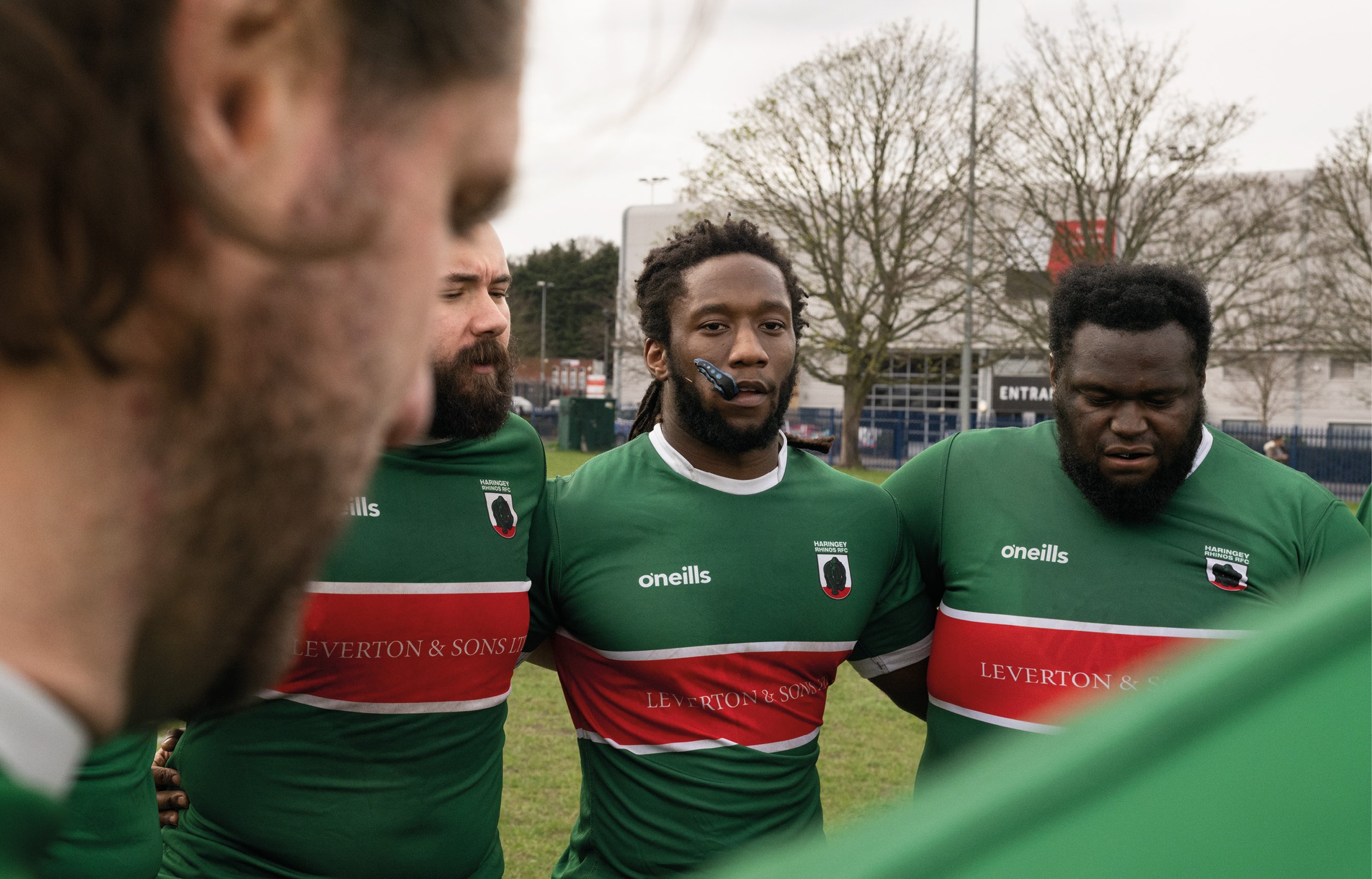
In the north London borough of Haringey, on a park pitch in Wood Green, close enough to the Tottenham Hotspur Stadium that you can clearly see the blue fluorescence emitting from its lights, you’ll find a rugby club which literally looks different to everyone else. ‘I recently joined the rough-as-all-fuck rugby team round here [north London],’ said Northern Irish comedian Vittorio Angelone recently on his podcast. ‘It’s me, twenty of the biggest black guys you’ve ever seen, and three Turkish guys who don’t really know what’s happening.’
Vittorio is among the newest recruits at Haringey Rhinos, one of the few amateur teams still going strong in north-east London, an area that’s among the most diverse around, with a non-white population of 43 per cent. For a sport whose followers in England are 87.8 per cent white, that represents a challenge for growth, at least in fighting perceptions. Haringey Rhinos, a club founded in 1963, are here for the fight. “There’s no chance there’s a club in the UK more diverse than us,” asserts Dominic Dyer, Haringey Rhinos’ captain. “First of all, we’ve definitely got the most black [adult] players of any club in London.
“The cheeky thing,” he continues, “is that if we’re playing against another side and they have one or two black players, we sidle right up to them and go, ‘you’re looking a little lonely bro, why don’t you join us, there’s a team full of us in Haringey!’.”
They certainly lean into their diversity too. “It’s Ramadan right now,” adds Dominic, “so we asked for water breaks at twenty minutes each half. No one’s gonna say no to that are they? There’s no other team that can get away with that … anyway it’s their own fault for not knowing that you actually can’t drink water during Ramadan.”
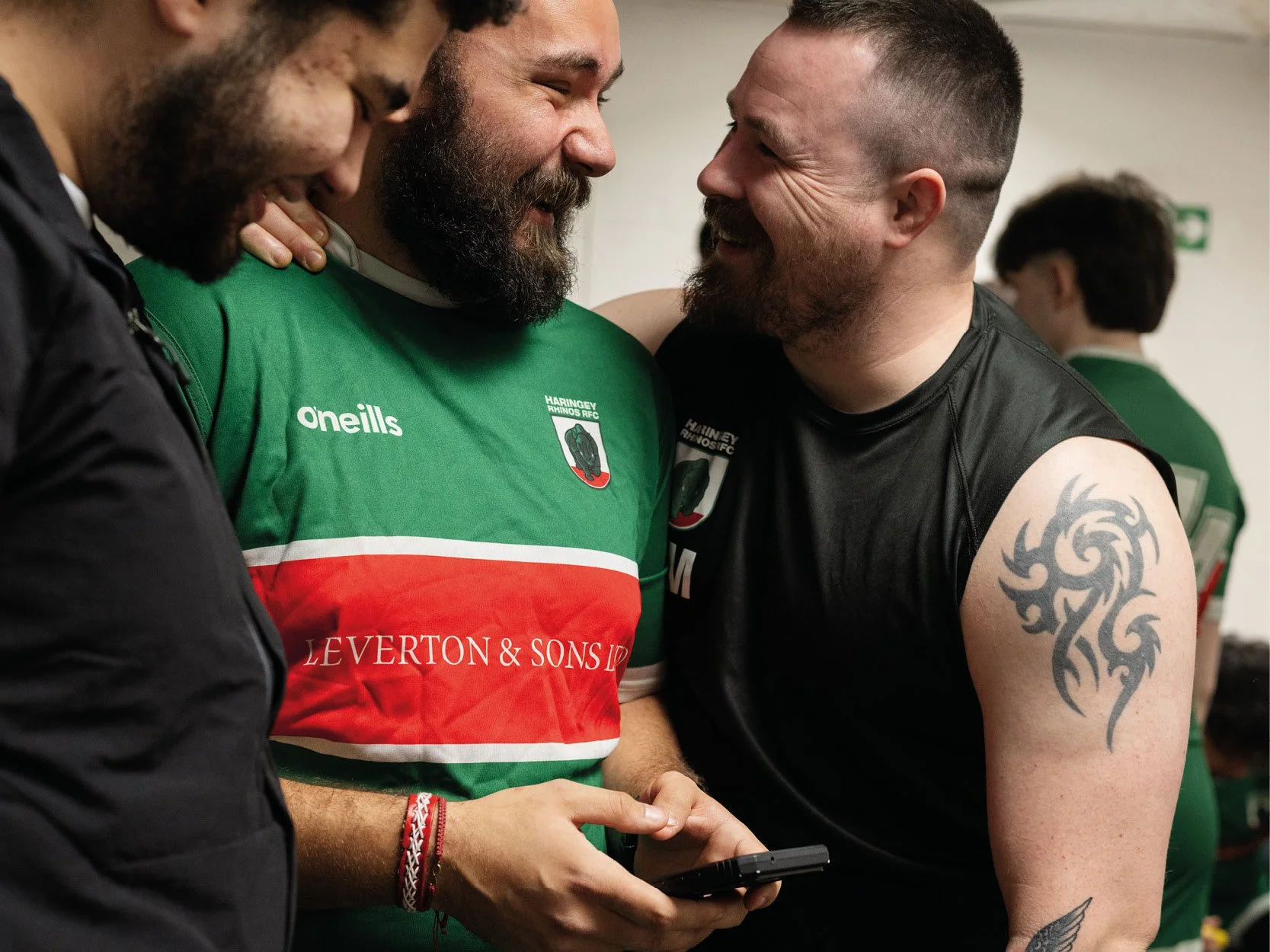
Dominic is a calm and measured presence in the changing room before today’s league game against Belsize Park IVs in the second division of the Middlesex Merit Table, the group of leagues outside of the traditional rugby pyramid. Inside, loud rap music blares and the players bob their heads as they get changed in a pre-match environment the like of which will be replicated hundreds of times across the country on any winter weekend.
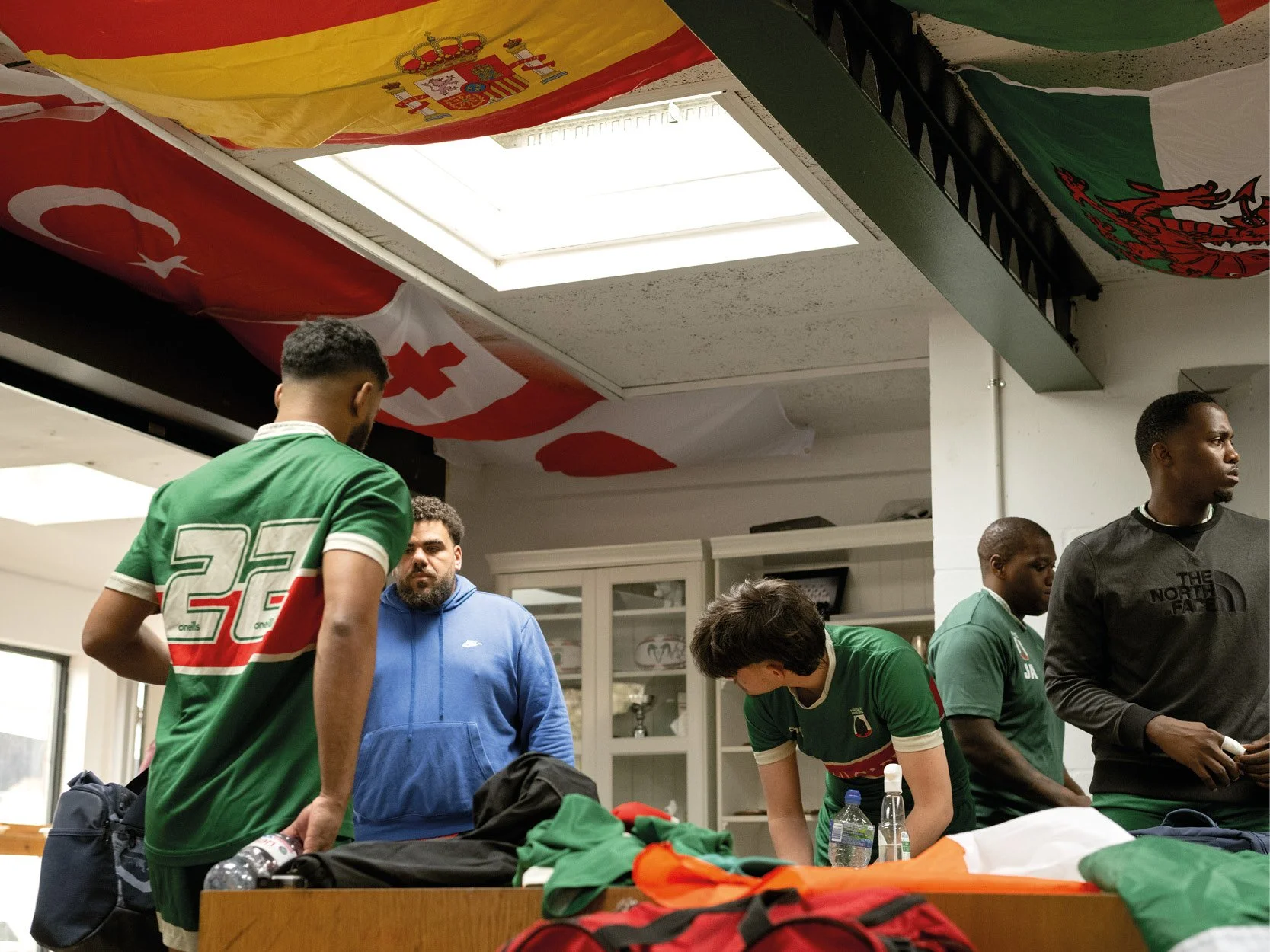
But cast your eyes upwards in the Rhinos’ changing room, and you will find exactly what it is that makes this club unique: a ceiling adorned with national flags, put up by players from those countries who have turned out for the team. There must be a dozen or two, from Albania to Kenya to Wales, and the Rhinos’ line-up today reflects this diversity, with eleven different nationalities taking to the field.
Perhaps the extremity of Rhinos’ commitment to diversity is epitomised by the sight of Hal Jones, a very tall and posh white man whom the other Rhinos have taken to calling ‘The Baron’, sitting laughing away next to Tayo, an enormous Nigerian tighthead prop. As well as being a forward for Rhinos, Hal has represented Great Britain in fencing, ensuring there truly is the full spectrum of life here. “I’m Jamaican, well my family’s Jamaican but I was born here,” explains Dominic while wrapping some tape around his ankles. “There definitely aren’t too many rugby players with Jamaican heritage, so I’m pretty proud of that. You’ve reminded me that I actually need to get a Jamaican flag on the ceiling!
“We have Jamaicans, we have a guy from Tajikistan, a guy from China, Algeria, Romania, Nigeria, literally every continent is represented … actually I don’t think we have anyone from South America. There’s got to be a big bloke from Chile knocking around somewhere that we can get in the team.”
Rhinos have made a very deliberate decision to celebrate and revel in their diversity, in a way that sets them apart from other clubs. Player-coach Aiden Morrison, who is here today in his capacity as a coach and pseudo spiritual leader, is sitting next Dominic and can’t resist chiming in on the topic of team diversity, especially on how it is perceived by opposition teams. “When you go to certain places in west London,” Aiden says in a quintessential north London accent, “you see the posh boys that we’re going down to play against and you’re like, ‘yep, we’re very different from these guys’.
“We had a guy come over from Belsize Park to join our team last year, and he was telling us that when we got promoted last season, the other teams ‘all caught wind of how we want to play rugby’. Apparently, the rumour is spreading that Rhinos are just turning up to games looking for a fight, so everyone’s been stacking their teams against us, playing their biggest boys, you know? We’ve been able to teach them a lesson, because it hasn’t worked out for most of them.
“This rumour is definitely not fair,” insists Aiden, “but it’s something we understand, because we don’t look like common rugby players. We know there’s always going to be a target on our backs in that sense.”
What is also striking is the significant age disparity in the group, as players no older than twenty ready themselves next to guys who are knocking on the door of vets rugby, possibly with “vets’ pass” already in hand. This is due, in part, to the fact that Aiden also coaches at City University of London, and is able to advertise Rhinos as a social rugby club for students who always have half an eye on a beer after the game.
It falls to the big boys to accommodate this commitment to youth, meaning Dominic, normally a blindside flanker, is sacrificing playing in his usual position today. “I’m not a hooker, but I am a hooker today bro,” he says. “For a lot of young players we try and bring through, it’s all about the experience to be honest. We don’t just want them to enjoy it, we need them to enjoy it for the future of the club. We need them coming back every week, so there’s free pints whenever they want them, and if they get hit too hard or too high, we have five or six of the biggest black guys in north London to show up for them.
“Because so many of us have grown up together, it means so much to pass on the uniform. We’ve worked hard to make sure the clubhouse is somewhere everyone wants to be too; we used to come here to do our GCSE revision back in the day.”
From GCSE revision to captaining the team, Dominic has had his own ascent which is mirroring that of the Rhinos who, for all their variations in age and background, are a serious and unified club. They’ve also gotten used to winning, securing three victories in their last four games before today. “So, we got promoted last year, and we had a bit of a slow start to this season,” explains Dominic. “To be honest, this was fine by me because I didn’t want to get promoted again as recruitment was dead slow last summer.
“But then around winter time the team really picked up,” he continues. “I was like, well maybe this weird way of doing things, getting people who have heard of us through Vittorio’s posts on Instagram and also nicking random black players from around the leagues, is sustainable.”
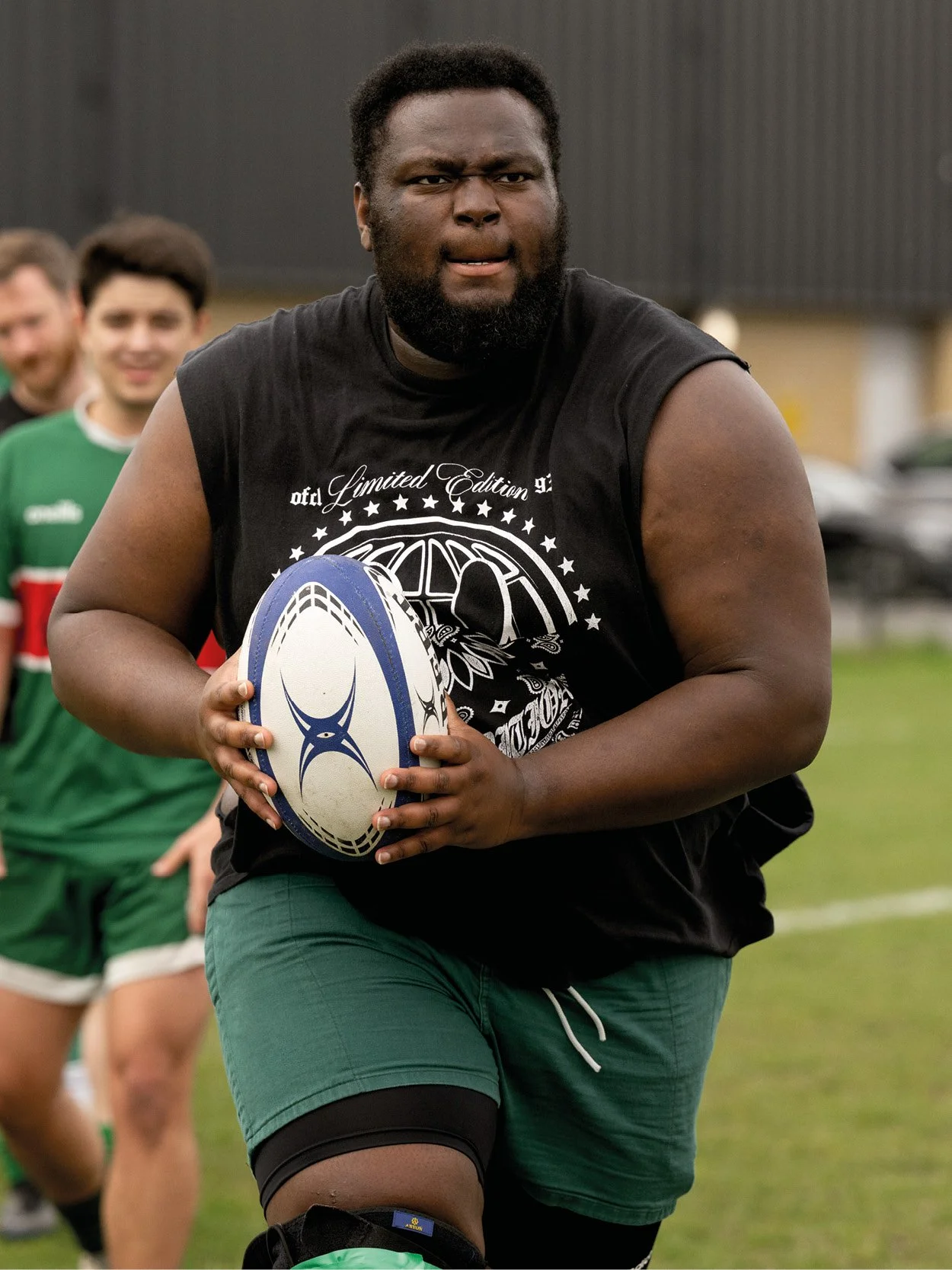
When we meet, Rhinos lie sixth in Division Two of the Middlesex Merit Table, having been promoted from Division Three in the previous season. The team that finishes first in the league secures automatic promotion, but the teams from second to fifth are put into a playoff bracket to fight it out for the second promotion place. With just two games left of the season, a recent string of wins means Rhinos are lurking behind the pack, just one point behind fifth and daring to dream of back-to-back promotions.
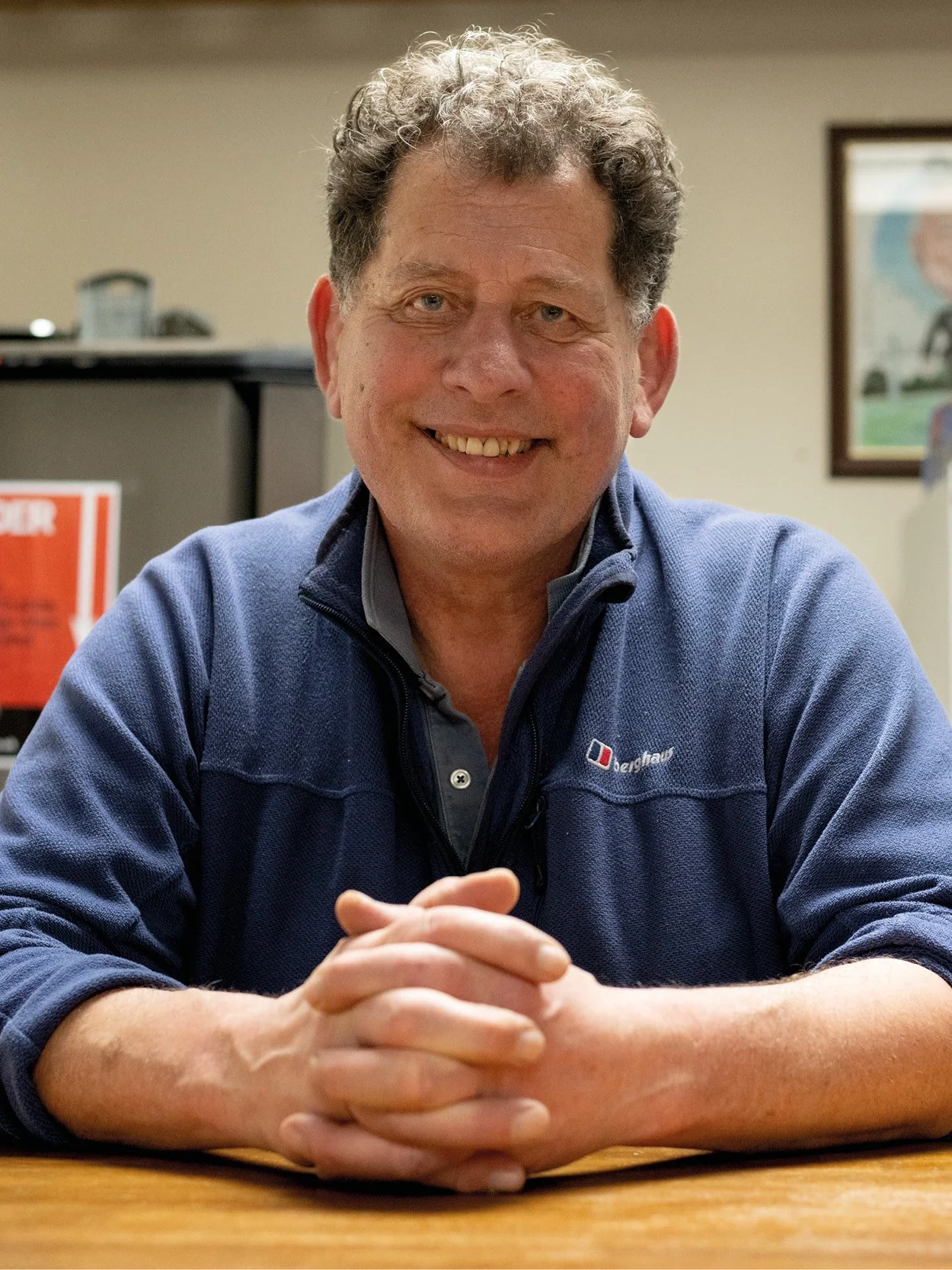
Today’s adversaries, Belsize Park IVs, are one of the teams above Rhinos, in third place, meaning this afternoon’s encounter is, in essence, a play-off decider. “Yeah Belsize are alright I suppose,” says Nick Critchlow, president of Haringey Rhinos, with a wry smile, “but we’ll have anyone on our day, I’m not just saying that either, it’s a fact.”
If he has any big-match nerves, Nick, known as ‘Mr Nick’ around these parts, hides it well behind a warm smile and magnanimous offerings of pints and warm food to those still in the clubhouse once Rhinos have taken to the field for their warm up. Keen to escape the music still blaring from the changing room, we retreat into a quieter corner of the clubhouse where Mr Nick insists that we eat something, ‘so that we don’t go out there on an empty stomach’, as if we were shaping up to play ourselves. “You expect coming into a new league to struggle a little bit,” he explains, “but we’ve ended up near the playoffs for this league as well.
“It’s happened before in the club’s history,” Nick explains, “where we’ve been promoted twice in two seasons and it hasn’t always been helpful, because all of a sudden, going up three leagues with the same players, they might struggle to adapt.
“But, to be brutally honest, at the level we play it doesn’t matter what league you’re in really. As long as you’re in a division that’s competitive and one which you have got a chance of winning, to me it doesn’t matter if we’re in league one or league nine.
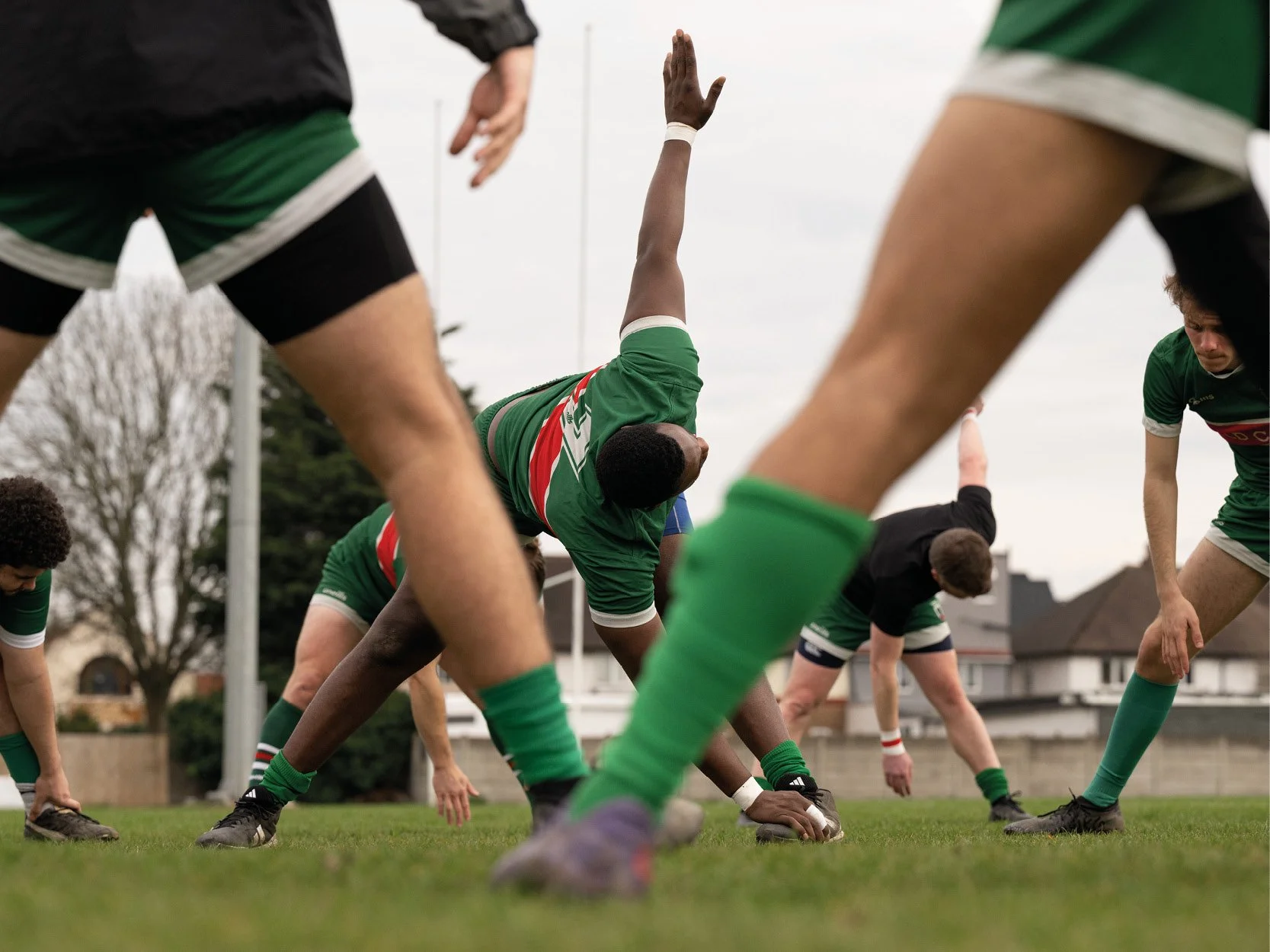
“The league we’re in now is really competitive and no one’s slaughtering each other by points, which would be a pointless situation to be in. In general we’re playing in solid, really tight games against clubs who are on the whole, bigger than us – Belsize Park are a much bigger club than we are and we also play Hampstead who have three teams.
“I hear some of our boys calling the west London teams posh, but I still think rugby is very much a game for all walks of life really.”
The point about Rhinos being a smaller club than many of their opponents is a salient one, but perhaps not as much as their geography. Put simply, this part of London isn’t very ‘rugby’.
Anyone who has ever been to Wood Green knows that it imbues a certain chaotic quality. Stepping off the tube, one is immediately confronted by the madness of the junction of Station Road and Lordship Lane, surely one of the loudest places in London, where dozens of shouted conversations are regularly interspersed by urgent honks of frustrated drivers.
The fifteen-minute walk down Lordship Lane and Perth Road to the New River Sports Centre, home of the Rhinos, is lined with kebab shops, a Polish supermarket, and the Kardesler Baklava Cake Shop, a north-east London institution.
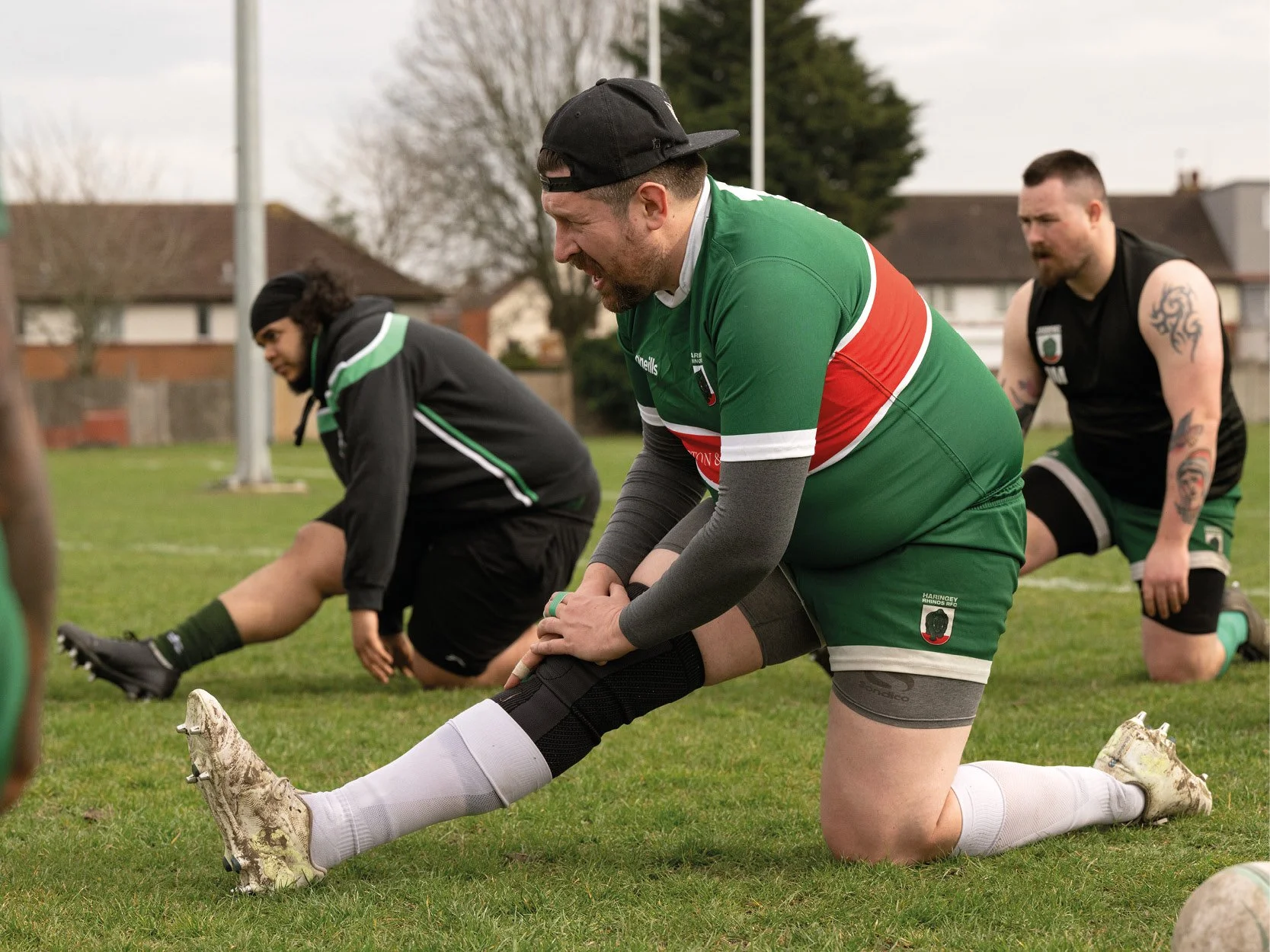
This can be heavily contrasted with the locations of the teams Rhinos play, many of whom reside in the leafier climes of west London. Already this season Rhinos have travelled to Hampstead, Belsize Park, Ruislip, and West London Rugby Club, who play near the Hornesden Hill Nature Reserve. Wood Green, to put it diplomatically, is a little more rough and ready than those parts of London.
Recent census data reveals that 36.7 per cent of households in North and South Wood Green are classified as ‘deprived in one dimension’, a figure notably higher than the national average of 33.5 per cent. Haringey also ranks among the London boroughs with the highest levels of wealth inequality, surpassed only by Tower Hamlets and Barking and Dagenham. This stark contrast is evident just a short bus ride away to the west of the borough, where one can find the affluent suburbs of Highgate and Muswell Hill with their gastropubs and arty shops.
As is often the case in some of London’s more disadvantaged areas, football is the dominant force here. Rhinos literally play on White Hart Lane, within walking distance of the Tottenham Hotspur Stadium and four stops away from Arsenal on the Piccadilly Line. Next to the New River Sports Centre are the White Hart Lane and Tottenhall recreation grounds, where there are seemingly ever-present games of eleven-a-side taking place. “Rugby has always been played here though,” says Nick somewhat defensively after mention of the area’s football prestige, “it’s not revolutionary for the game to be played in north-east London, but these days there are so few rugby clubs here.
“Old Totts [Tottonians RFC] used to be up White Hart Lane and they packed up and moved a few years ago. Old Grammarians have now moved further out there near the Green Dragon Lane, way deep in Enfield. It does feel like we’re the last club standing our ground on this patch.
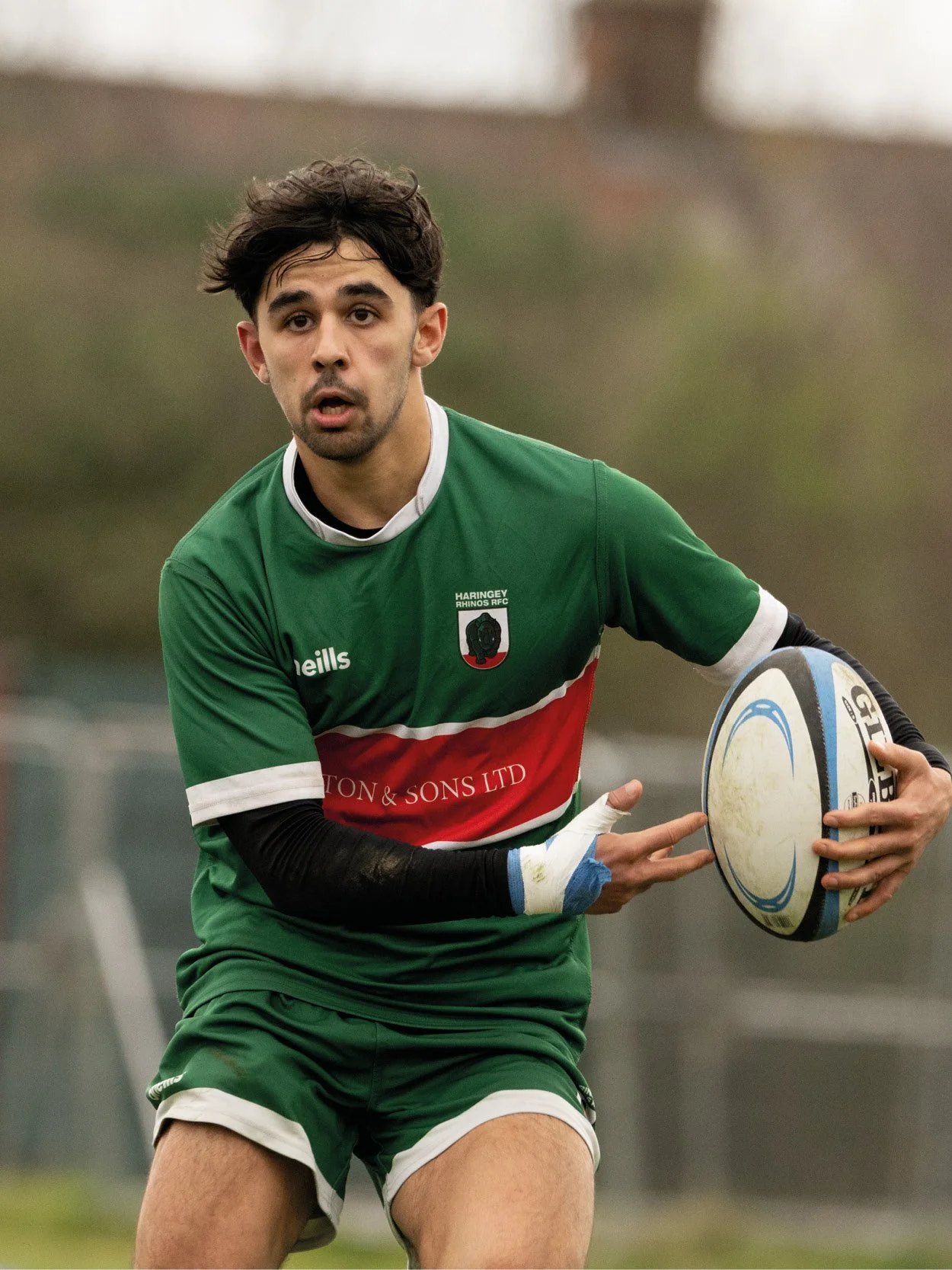
“The origins of the club started off in the 60s,” explains Nick. “It was started mainly by Welsh blokes in the area, who were teachers from local schools. They started the club so they could all get together and play and also bring in some of the lads from their schools so they’d have a club to play for as well.”
As if conjured by our discussion of the club’s history, two old boys, one called John and another simply known as ‘Magic’, enter and shake Nick’s hand heartily. Thrilled at the prospect of sharing the history of the club with an interested stranger, the three men attempt to trace the history of the club from one location to another, a task which proves harder than one might imagine.
“No, no, the club was initially based in Crouch End,” Nick says firmly, after an incorrect assertion from Magic, “and we were a bit nomadic for a while, playing all over north-east London. We were in that place in Lordship Lane [the road that connects Wood Green with Tottenham High Road] for a while,” intervenes John, “and that really was a shithole.”
“What you’ve just heard is very unusual,” Nick says amid the ensuing laughter. “If a rugby player says a place is a shithole, it really is a shithole. I do remember that place; it was proper wipe your feet when you left stuff.”
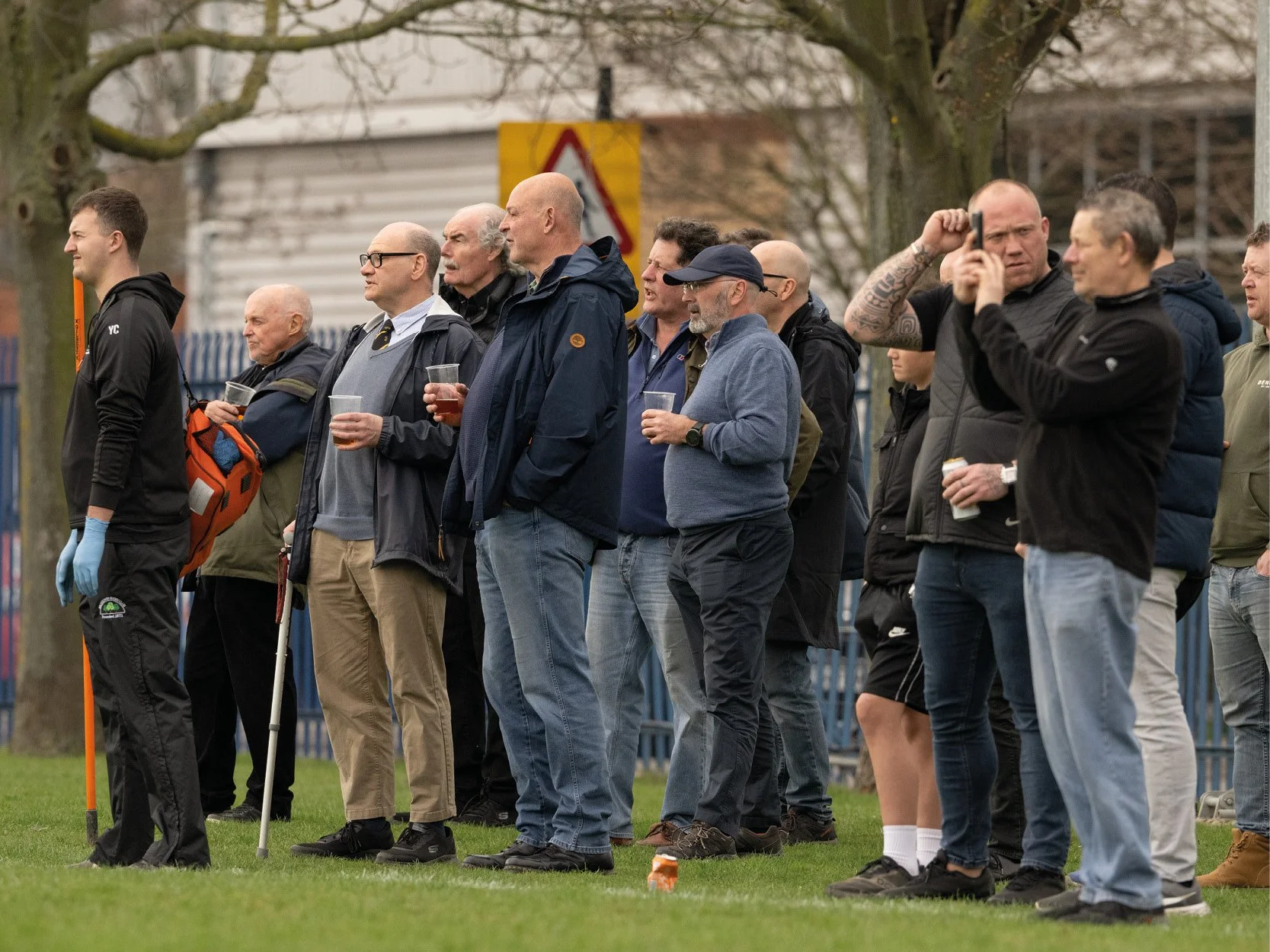
John and Magic have turned up in their smartest gear as today is not only a crucial playoff decider on the pitch, but the date of the annual lunch put on for the old boys, the Rhinos of yesteryear. At the far end of the clubhouse is a small room bursting with sausage rolls and a splendid array of sandwiches.
As Nick, John and Magic giddily reminisce about old European tours between mouthfuls of pastry and pork, Aiden is wildly gesticulating on the side of the pitch. He is leading his team through their final paces in the warm-up, urging Rhinos to move the ball faster and hit the tackle bags harder.
Despite Aiden’s demands and the pressure of a big game looming, there is an abundance of laughter in the warm-up, and a definite community feel as volunteers muck in to make sure everything is ready for the game.
Aiden has played for Haringey Rhinos since he was fifteen. A local boy having gone to school in Enfield, a teacher encouraged him to go to school rugby trials and he abandoned all dreams of other sports on the spot. This is his fourteenth year playing for the club and third as player-coach. “I’m not supposed to be in this role I can’t lie,” chuckles Aiden. “We had this coach who was supposed to be here for three years, and then one year in he was like ‘yeah, I’m done with this’. Then my friend took over, he’s just one of those club guys that’s always around, but for the life of him he couldn’t coach rugby. He just came to me and asked me, he’s like, ‘do you mind doing it?’. I said that I’d take a couple of sessions towards the end of the season, see if the boys reciprocate. At the time I was 25, so there were quite a few lads older than me. Telling older guys who have played rugby for longer than you what to do sometimes doesn’t go down well.
“But the reception I got was quite good. I clashed heads with some of the older players, but it was a thing of ‘you fall into line, or you find a new club’.”
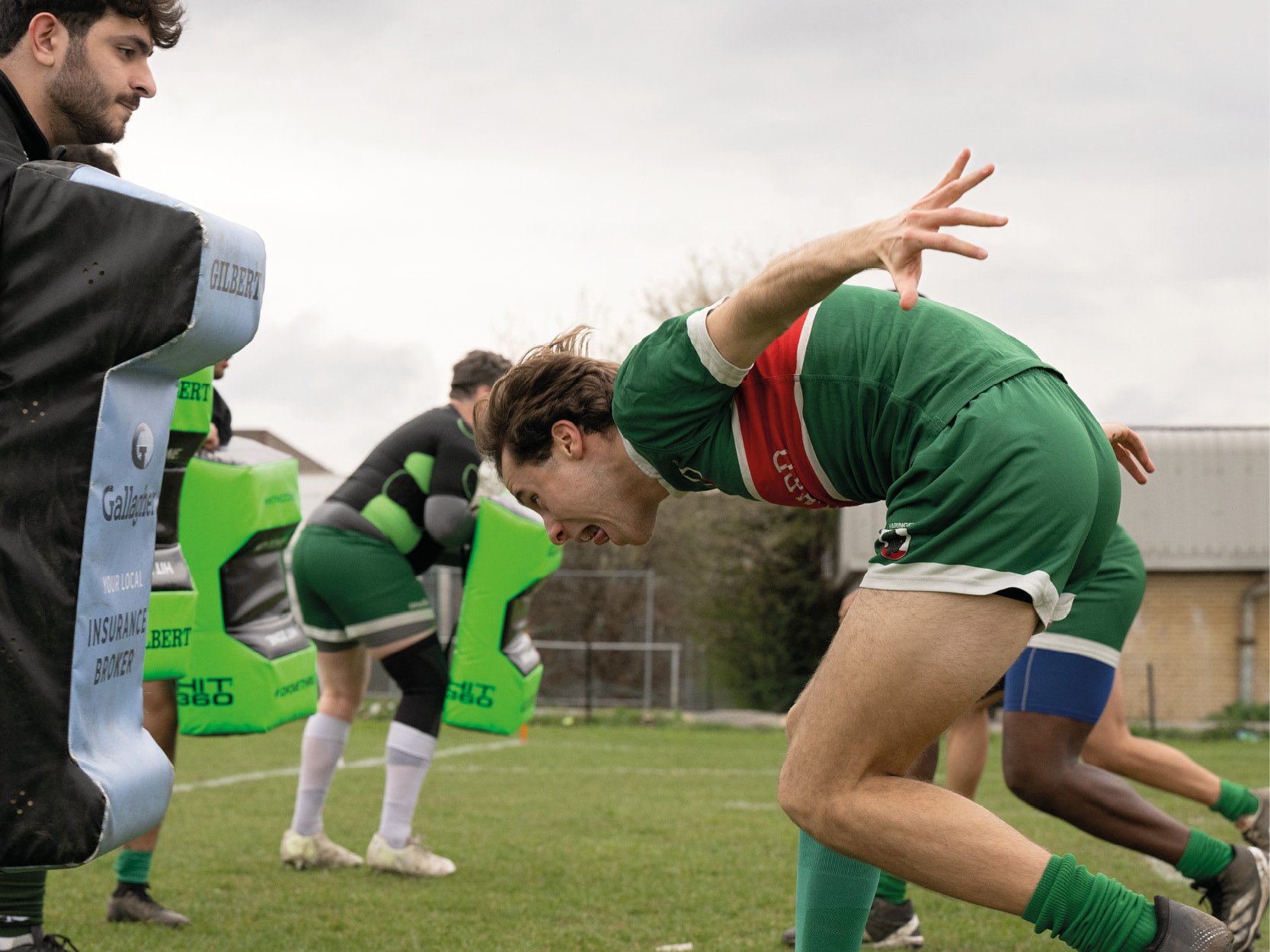
To make such a statement is typical of Aiden’s character, as he is at once exceptionally friendly, but totally uncompromising. While he’s not playing today, he still turns out for Rhinos sometimes, despite a nagging injury which has kept him sidelined in recent years.
As kick-off nears, he brings the Rhinos together for a final team talk. He bellows commands at the gathered players, imploring them to go out and hit Belsize Park hard early doors to give them a true and proper welcome to Haringey. Aiden is a principled coach, and his values align well with the current iteration of Haringey Rhinos, where there is a strong focus on accessibility and inclusion – principles that are upheld at every level of the club.
At Haringey Rhinos, it’s completely free for kids to play rugby. The minis section, launched just over a decade ago, numbers over 200, including boys and girls aged five to seventeen of all abilities, and operates without any training or match fees. The club raises £10k each year to cover all the expenses for the minis and regularly seeks support through appeals to ‘sponsor a junior Rhino’. With over seventy per cent of the young players coming from BAME backgrounds, Aiden highlights how this helps foster a culture of inclusivity within the club. “Everyone else, they’re paying like £200 a year, which obviously allows them to have a nicer kit, maybe some nicer facilities. But luckily, through sponsorships and funding, we were able to give the kids boots, gumshields, some recycled kit for free. We want to prioritise getting people involved, instead of making it elitist, where you have to have money to play.
“I mean, I remember first playing,” Aiden smiles wistfully, “I would have liked that for sure. Getting into rugby wasn’t that strange for me because my mum’s side is Irish; my uncle played rugby and my cousins in Ireland play rugby. My Irish lot were pleased when they heard I was playing; they thought I was going to be a footballer and before that, I was going to be a boxer. It was cool really, they just really supported me, no matter what I chose, and the same goes for my Jamaican side of my family too.”
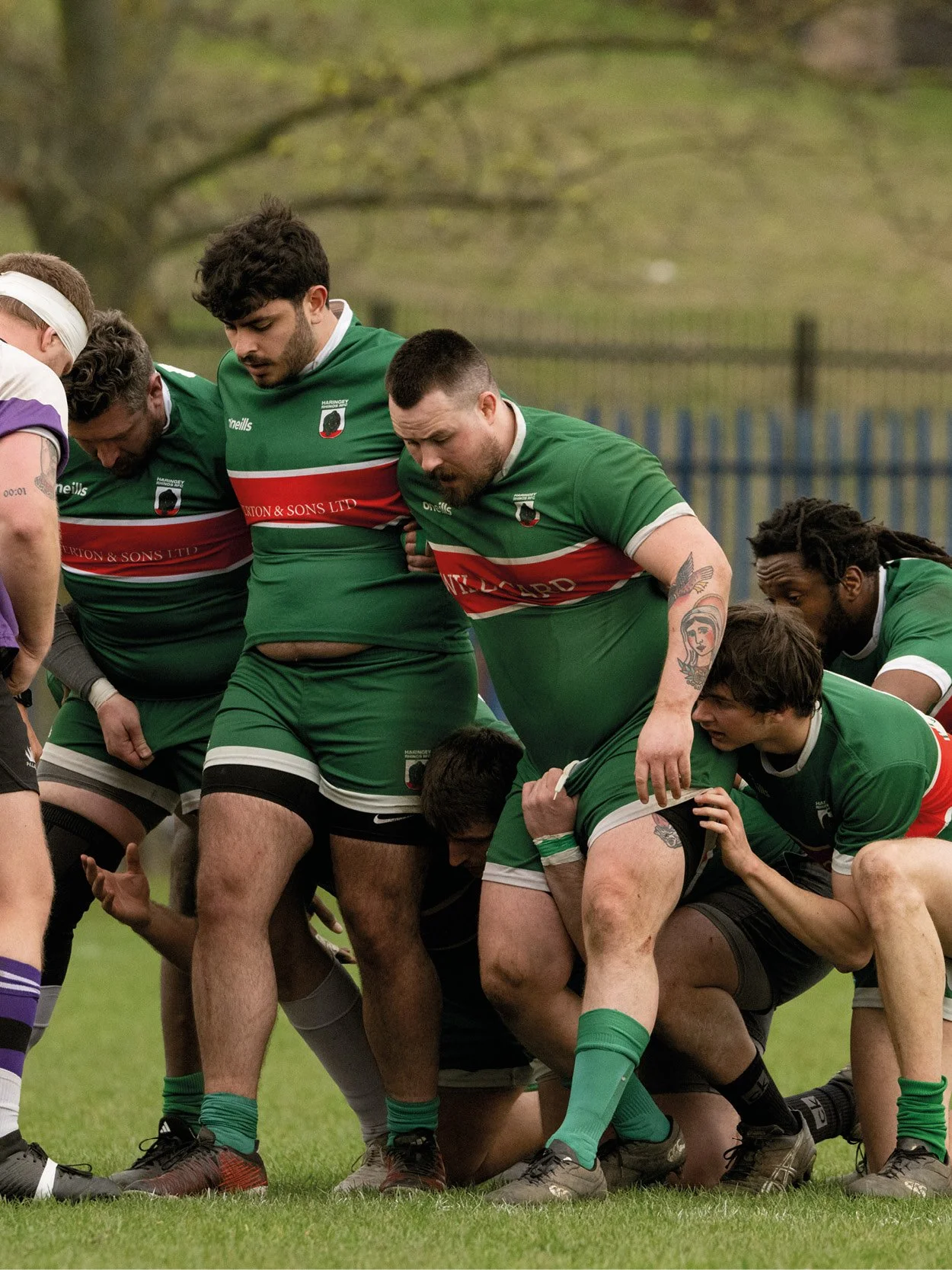
As the game kicks off, there is a tense vibe in the air reflecting the magnitude of the encounter. This is soon quashed as Rhinos score a well-worked early try and nail the conversion, taking a 7-0 lead. However, Belsize Park, following a penalty try which causes much consternation among Aiden and the Rhinos substitutes, score right before half-time and take a 12-7 lead into the break.
On the side of the pitch, the old boys aren’t really watching the game too carefully, thrusting their cans towards each other and punctuating the tense air with hearty laughter. The same cannot be said of the current iteration of Rhinos, as Aiden prowls around an imagined technical area and the substitutes keep their eyes locked on the action. Aiden explains how this is another conscious decision to re-orient the priorities of the club.
“So, when I first joined Rhinos, we were known, notoriously known I should say, for being a drinking club. Rugby wasn’t the priority really, the priority was getting off the pitch and getting into the bar.
“In a major sense, we’ve totally shifted it so that rugby is the priority now, and you have to earn the drinks that you have after the game, it’s not a reason to turn up.
“Of course if we win, we enjoy ourselves properly, you can tell the mood’s better in the clubhouse after a win and people will stick around longer. After a loss, people are dead quick to leave, even the older boys who were around during the heavy-drinking era won’t stick around if we’ve lost.”
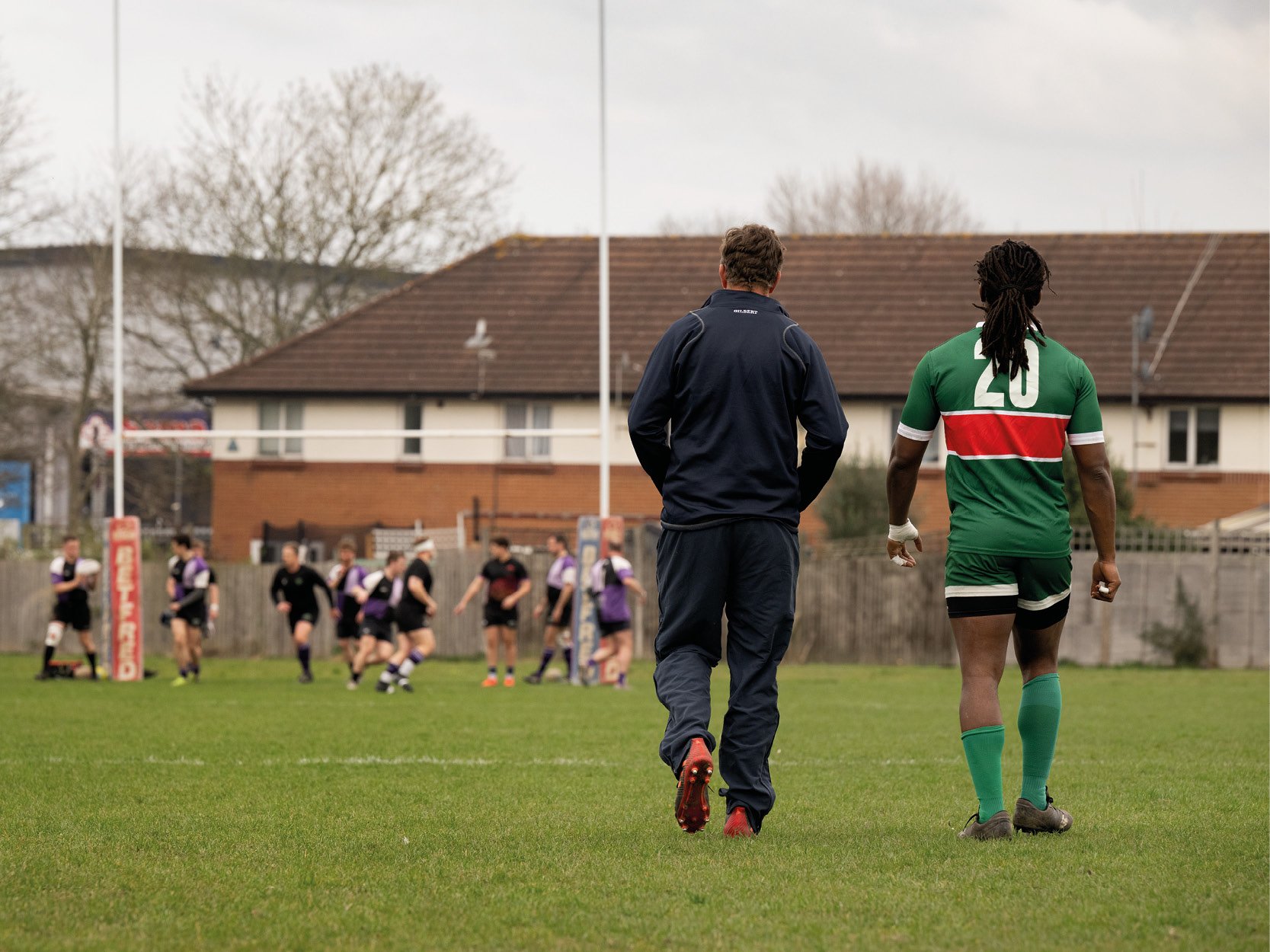
Fears of Rhinos losing this particular game are furthered as Belsize Park score a try immediately after half-time. Despite spirited resistance from Rhinos, their opponents are a slick, powerful outfit and end up winning the game 31-14.
In the final moments, Aiden grows increasingly irate and is dismissed by the referee for using bad language in an episode which is actually a case of mistaken identity as, while he was venting frustration, the swearing instead came from an injured Rhino who had come down to watch the team play.
The disappointment around fading prospects of a double promotion is palpable as Aiden again gathers his team, assuring the players that they can keep their heads held high despite defeat and instructing them to chat to the old boys who have made the effort to come down. The promise of the impending ‘court’ session also brings mischievous smiles to certain players.
Though it was a disappointing day for Rhinos, their fly-half put in a commendable performance. Scorer of the neat opening try, Zac Mistry, a second year accounting and finance student at City University of London, was the best player on the pitch. After Dominic sustained an ankle injury in the second half, the young man from Carmarthen had to assume the role of captain for the remainder of the game, illustrating how highly thought of he is among the group. “I’ll play two games and then two training sessions every week,” says Zac, who also plays at uni. “To be honest with you mate, I’m absolutely knackered.
“I love being in London,” he continues, there’s so many cultures and it’s really helped me as someone who has grown up somewhere very different to that. I mean look around; [Zac gesticulates around the clubhouse, to indicate the breadth of culture on show in this very room] you wouldn’t get this in Wales.”
“If you check our team sheet on Instagram before every game, there are flags next to every player’s name. I love that they do that, and I love that I’m repping the Welsh boys. But in the backs alone, I have guys from Bangladesh, Scotland, Portugal to pass to behind me – it’s class. You know I had to put that Welsh flag up on the ceiling too.”
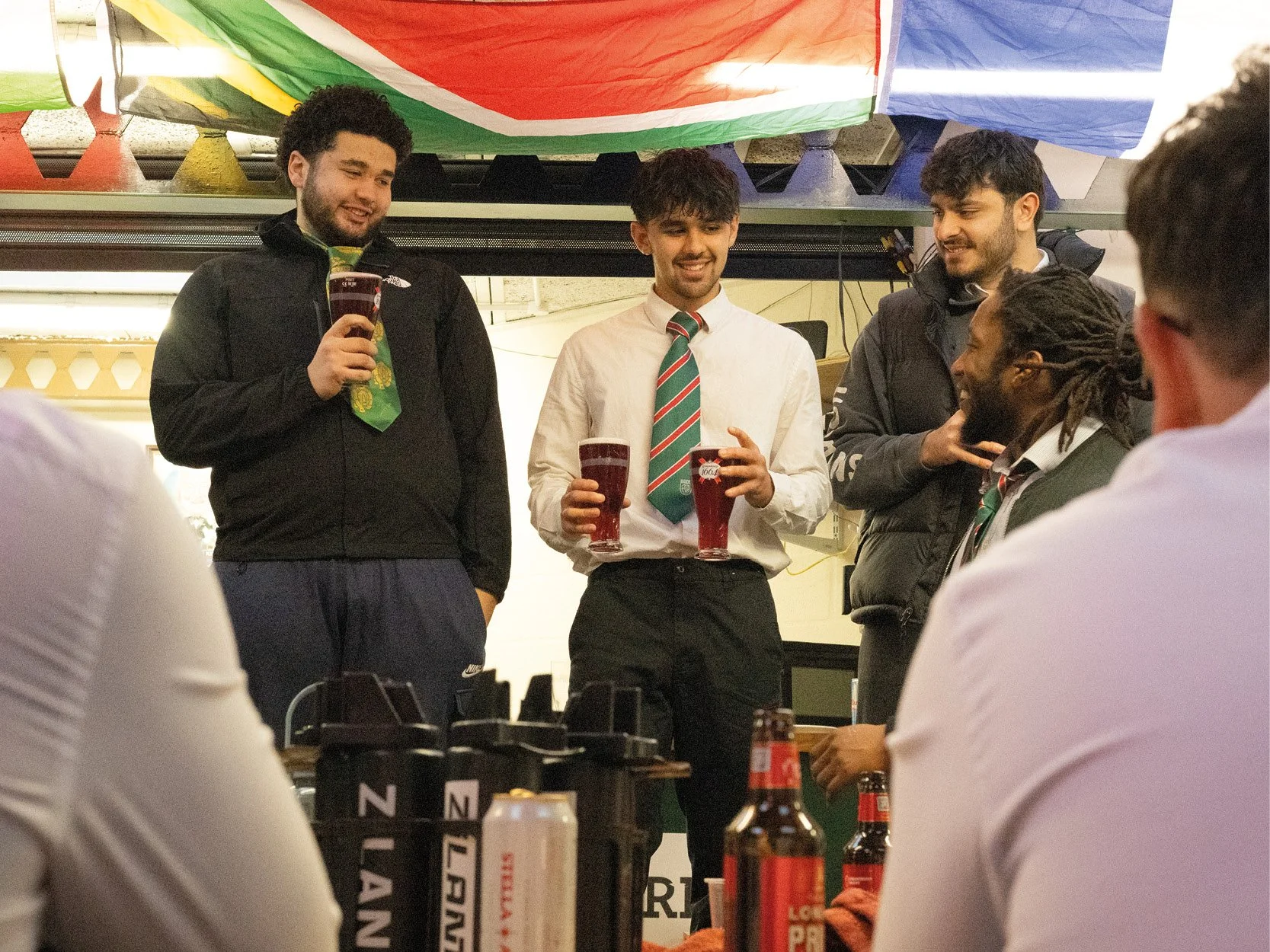
Under Zac’s Welsh flag the clubhouse is a happy scene despite the loss, as the laughter volume quickly increases after the players get their hands on a beer and a hot dog. Off-colour jokes begin to fly with marked freedom and both Rhinos and Belsize Park players make great headway with the special ‘four drinks for £10’ offer. “Uni is very serious, maybe a little bit too serious,” admits Zac. “Playing for Rhinos is serious when you play, but outside of the games I’ve really found a proper sense of community. More than anything else it’s just really fun to be honest, I mean, we’re a bunch of lads in our twenties and thirties on a Saturday in north London, we’re not going to be monks are we?
“If you want it to be boozy, it will be boozy. Usually I just leave straight away, but when I do stick around everyone buys me drinks. So, it’s usually worth it.”
During a speech from Dom and the Belsize Park coach, Aiden begins to wield the gavel in his hand, Samurai-style, preparing to take charge of the room for the court session. Before he can do that, drinks are being readied for specially selected players to step onto a bench and see off.
“Shit man, I might get our team’s man of the match,” Zac says, nervously eyeing the pints being poured. “I was also a few minutes late and I captained the team for the first time, so it could be a long night for me.”
Story by Scott Duke-Giles
Pictures by Karen Yeomans
This extract was taken from issue 30 of Rugby.
To order the print journal, click here.