RFU Knockout Cups
The cup final was the biggest of days: towns and cities would empty, Twickenham was full and winning could create legacies for clubs and players that lasted far beyond the final whistle. But then, having started almost a hundred years too late, the national knockout cup was gone, and its demise wasn’t pretty.
Getty Images
Rugby pioneers are often lauded, sometimes even knighted, or at the very least given a nod of acknowledgement at the end-of-season dinner and dance, but the forward-thinking Staff and Gentleman Cadets of Royal Military Academy Woolwich just don’t get enough credit. And when we say forward-thinking, they really were, coming up with a concept for a challenge cup more than a century before the RFU actually got its act together and launched one. You could suggest, by RFU standards, that’s a quick turnaround, but this was 1875 – twenty years before league broke away – and with the ‘gentleman cadets’ even putting up £150 to fund the silverware. And people got jittery. A sub-committee was set up to look into the concept, but eventually the Governor of RMA Woolwich, no less, got cold feet and pulled the plug. ‘But the RFU, though it had been tempted by the munificence of the RMA’s offer, was always basically against a National Cup’, wrote AW Ramsay, just over a century later, when president of the RFU.
That he did so in the programme of the 1980 Twickenham Cup final between Leicester and London Irish, shows how far the RFU shifted its position on the concept, even if it took some time for the idea to come to fruition.
In those early days, rugby union was always panicked by the notion of organised competition: more eyeballs, more public interest, more money, it was only going to end up one way: professional sport.
But some of those who were involved in the sport at club level would try to push the needle, such as Bedford at the 1967 AGM, where they had the audacity to suggest a knockout cup. Gilbert Cook said to the club reps: ‘The Bedford club feel that a competition should be played annually on a knockout basis for a cup.
‘We suggest that a competition would attract great interest and support from both players and supporters, and it would be likely to increase the playing standard of the game in England.’
They found unlikely support in arch rivals Northampton and a 1968 knockout cup seemed to gain traction, only for it to ultimately get out-voted 426 to 115.
Rugby, it was considered, wasn’t supposed to be watched, only played. But the idea of a cup captured the club game’s imagination; it wouldn’t go away, eventually returning to the table in 1970, when the executive committee of the RFU met at London’s Hilton Hotel on Park Lane. There could be a cup, but there was ‘no obligation for final at Twickenham’. And also, most pertinently, ‘no matches in the qualifying rounds and beyond should take place on a Sunday’.
In January of the following year, the cup was announced, just shy of the RFU’s one-hundredth birthday. They said two years of consultations had taken place, the reality was closer to one hundred – mutterings about a cup were almost as old as the RFU.
Getty Images
Snappily named the RFU Club Competition, it would feature 32 clubs, chosen by status and, where that wasn’t enough, regional play-offs, such as Cheltenham facing Lydney to represent Gloucestershire and Somerset. Lydney won, and their prize was a visit to Bristol. Other plum ties in that first round of the first-ever cup saw regional rivalries play out, including: Bath v Gloucester, Penryn v Plymouth Albion, London Scottish v Harlequins, London Irish v Saracens, London Welsh v Oxford and Sidcup v Blackheath.
Over four knockout rounds, the cup saw great games: Halifax’s 13-9 defeat of Jack Rowell’s Gosforth; glamour side London Welsh fielding eleven internationals in a second-round 7-33 win at Saracens, where 5,000 poured into Southgate’s Bramley Road. The Welsh looked unstoppable, until they were stopped in the next round with a narrow 4-9 defeat by Gloucester in front of 7,000 at the Old Deer Park. Gloucester were lucky in the semi-final too, it seems, taking ‘victory by thuggery’ according to one account, in their 6-6 draw with Coventry which, as they were the away side, was enough for them to go through at the expense of their hosts.
Wilmslow were perhaps the shock side, admittedly with Steve Smith among their number and with a growing reputation, as they reached the semi-final at the expense of Harlequins, following a 7-16 win in Twickenham, only to be despatched by Moseley, 18-10.
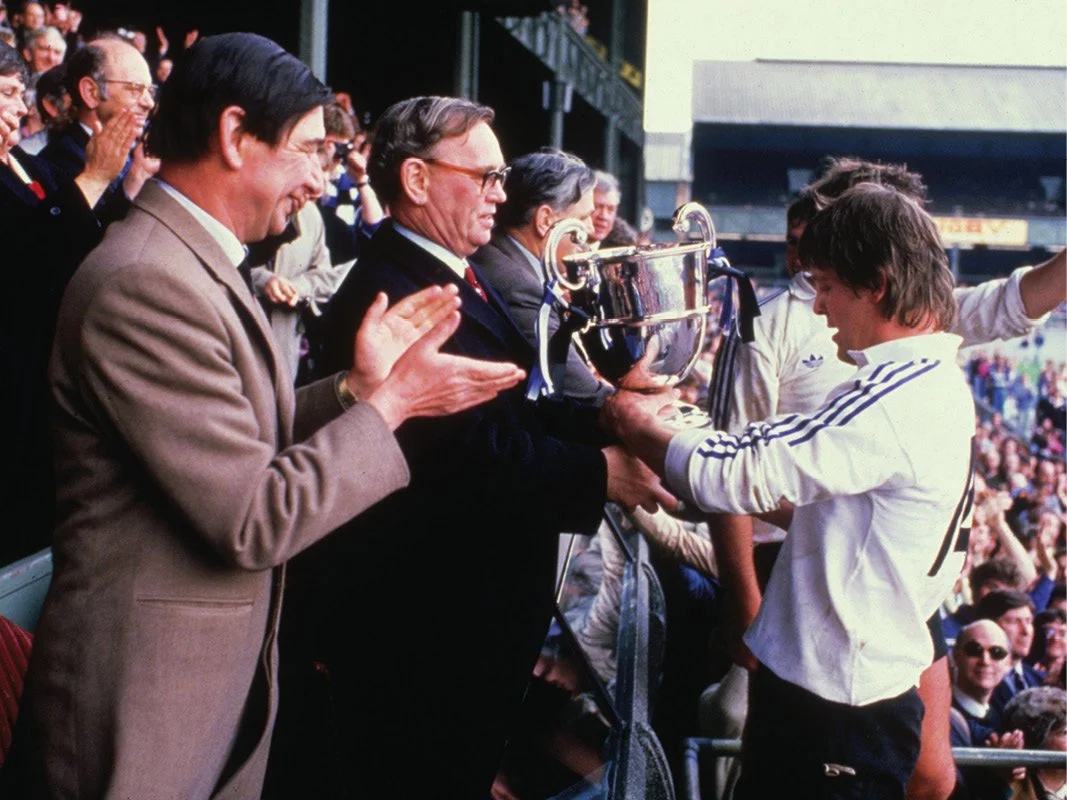
And so, with the knockout rounds completed, it was Gloucester and Moseley that met in a Twickenham final. There was a 10p matchday programme, simply made in black and white, with the budget allowing a sparse use of red ink. It might have been understated by today’s standards, but it still told the most vivid stories, with the notes making mention of nearly all the Gloucester side being ‘home produced’, born in and around a city, ‘famed for three things: ‘cathedral, elvers and rugby football’.
Elvers are tiny eels, caught in the Severn for six weeks in the spring, in case you weren’t up on Gloucestershire river-life. Because of the eels, Gloucester fans were known by some as ‘Elver-Eaters’, with elver nets said to make the occasional appearance at games. More of that later though.
Ten and a half thousand fans had gathered at Twickenham; with £10,000 in gate receipts, each of the 32 participating clubs earned £240. A big chunk of the support came from Gloucester. “I think we as a club really did embrace the cup,” explains Robin Cowling, the loosehead prop for Gloucester that day. “We weren’t a typical rugby club, we were really a working men’s club – we were closer to Wales in many ways, we even played one fixture a week in Wales – and we desperately wanted recognition for what we were doing.
“The paper would make up a league table, and we were leading that, and there were other bits and pieces [of recognition], yet we didn’t produce any England players; we were a club with a big chip on our shoulders to say the least. We weren’t fashionable, we weren’t Harlequins or Cambridge University or anything like that, so the cup fell into our hands, it was just what Gloucester wanted, so that everybody had to recognise us.”
Not that everyone was happy about their involvement. “John Reason of the Telegraph hated us, he said we had no hope,” recalls Robin. “We had all our games away from home: Bath, Bristol, London Welsh, Coventry. And he always slated us, sometimes he wouldn’t give your name, he’d say ‘left hand side of the scrum’. But we had a captain, Mike Nicholls, and a committee man Peter Ford, who revelled in this position of not being typical, and I think we brought something special to it.”
Getty Images
Such was their desire to win, they even took time to read the fine print. “We knew the rules,” says Robin. “The game against Coventry [the 6-6 semi-final draw], they didn’t know the rules of a drawn position, but we did. When the game was a draw, they thought it would be a replay at our place, but we knew we’d gone through as the away team.
“We had targeted the whole thing, and our crowd absolutely loved it.”
While not ‘fashionable’, Gloucester were at least one of the elite clubs when it came to fixtures. “Nobody could break into that,” says Robin, “it was ourselves, Coventry, Bedford, Moseley, sides like that, and no side could break into that fixture list; it was traditional, we all played certain sides on certain dates, for fifty or sixty years … it meant the cup was an opportunity, for sides like Wilmslow, and others, to break into it.”
The conclusion of the cup run didn’t just bring the players and the fans to Twickenham, it also brought some other, albeit temporary locals to the home of English rugby. “Elvers are a real Gloucester speciality,” says Robin, picking up the slippery tale. “And April, when the final was played, was when the elvers were in the river. They’d travel all the way from Mexico, via the Gulf Stream, up the River Severn, and it was only Gloucester people who knew how to catch them. Gloucester people all had their own tump – a lump in the ground – where you could stand and net the elvers as they came up stream.
“One memory of that final win [Gloucester won 17-6] was coming off the pitch dripping wet with elvers, because after the final whistle, the fans had poured buckets of them all over us – and they were astronomically expensive too. Revolting little slimy things they were though.”
The win was huge for Gloucester: the club had put on coaches for fans and family, and with no limit on tickets, much of the city had headed to south-west London. The players were the pride of the city, even being taken to the Houses of Parliament by the local MP for a celebratory dinner.
The cup continued to grow, eventually gaining sponsorship through John Player cigarettes in 1976, with Coventry (’73 and ’74) and Gosforth (’76 and ’77) becoming back-to-back champions, only Bedford breaking their hegemony in 1975’s win over Rosslyn Park, who became back-to-back final losers a year later.
By the time Gloucester returned to Twickenham in 1978, with a crowd swollen to 24,000, it was to face Leicester. This time Robin was on the other side, albeit not on the pitch. “I was injured on that first final, but played the next three,” says Robin.
Getty Images
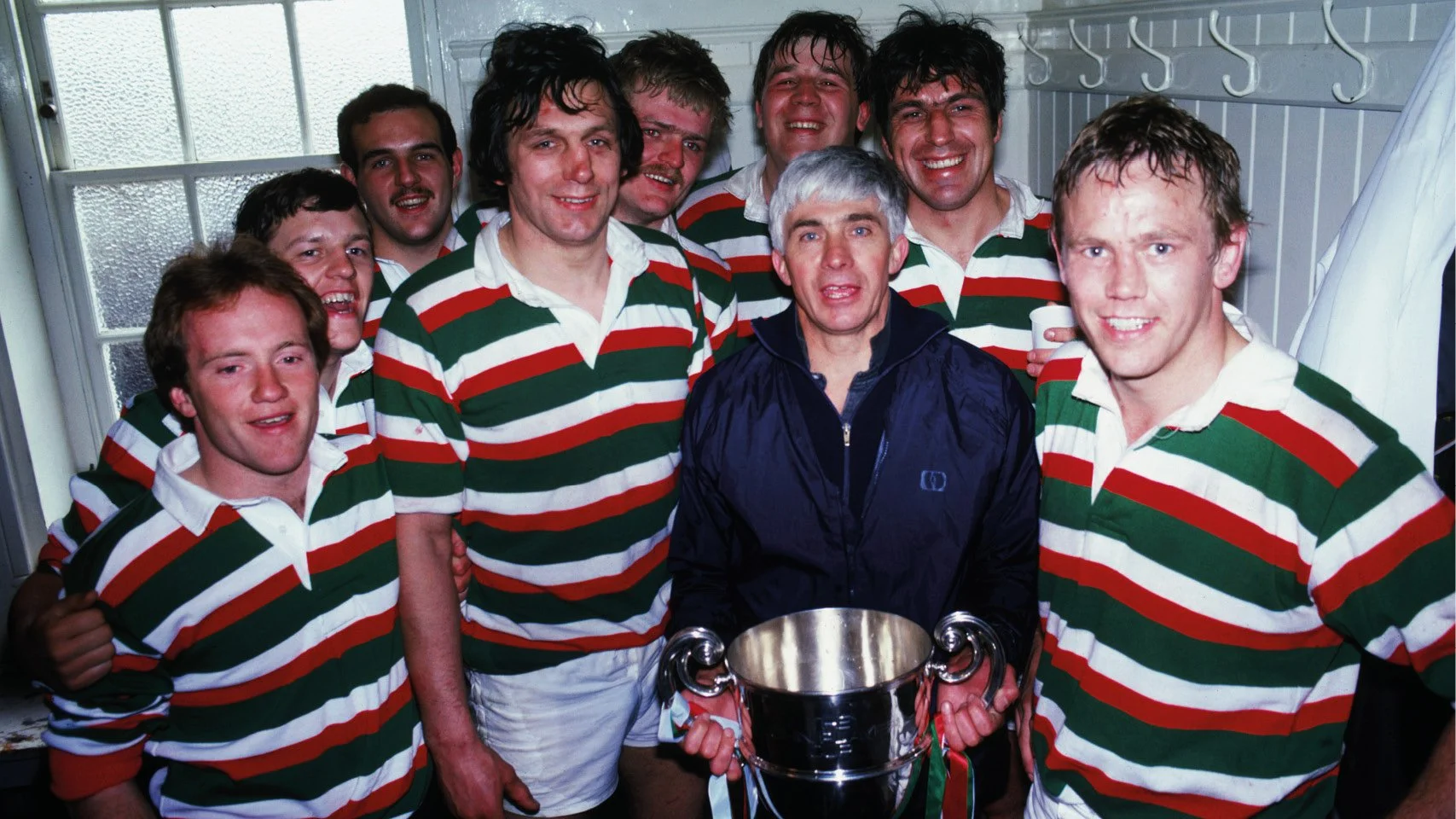
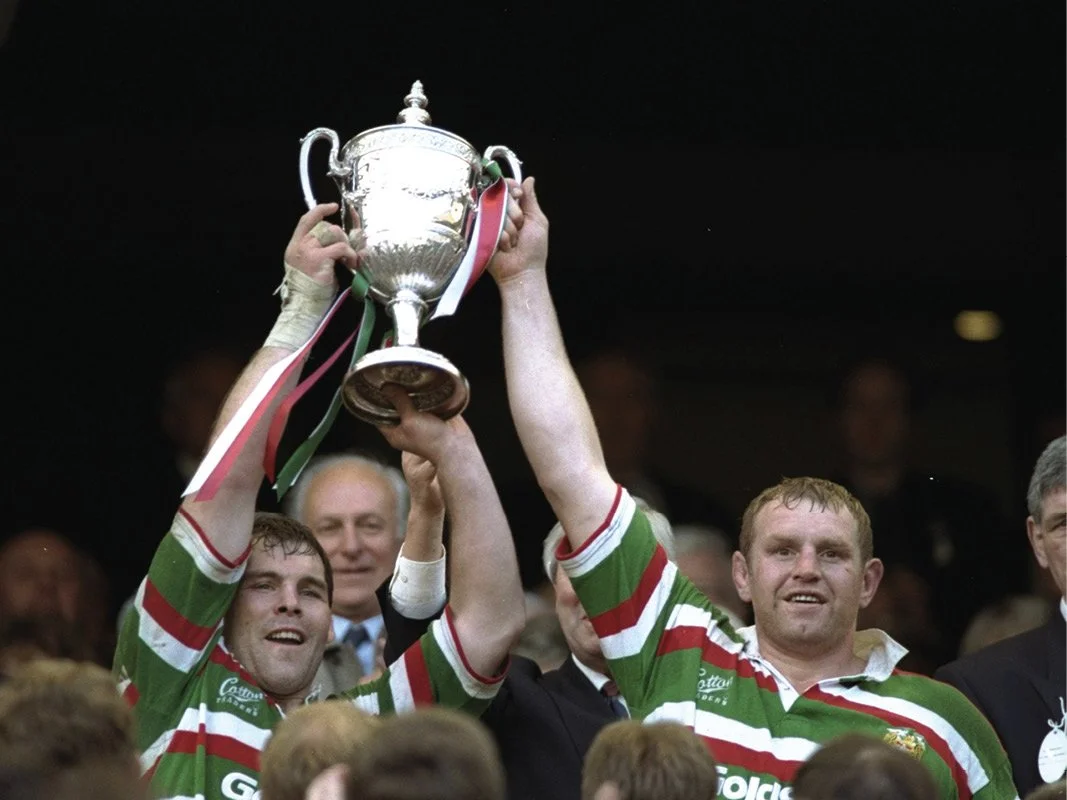
Gloucester did win a second final (6-3), but Leicester were a team coming of age, and made up for it with three consecutive wins, from 1979 to 1981, against Moseley (15-12), London Irish (21-9) and Gosforth (22-15). “It was a period of huge change,” continues Robin. “For the [Gloucester] final we [Leicester] had a very small emblem [of the shirt maker] on our shirts, but we were told to take it off, it was advertising.
“We were also the first side to have advertising boards around the perimeter of the club to get sponsorship: we very, very forward-thinking, and so was our coach, Chalkie White – he was ahead of his time.”
It was all about the detail with Chalkie. “It was at a stage when half-time meant you had a bowl of oranges, but one September, Chalkie weighed us before and after the match and found we were losing 10lb of moisture, so he made us drink water. It was always a myth that you should never drink water during a game, but he changed that.
“Leicester were way ahead of their time,” repeats Robin. “Pete Wheeler, who was captain, realised you needed to recruit and not just rely on who came through at Leicester, so he went out of his way to recruit players like Clive Woodward. Recruiting? People had never heard of it!”
The team that won the cup continued to change the game, the sides were peppered with greats of the game, not only Wheeler, but Les Cusworth, Dusty Hare, Paul Dodge. “He was in the Leicester first team at seventeen,” says Robin. “Chalkie would leave the forward work to us, but his real knowledge was how to play with the ball after that. We were way ahead of other teams when it came to retaining the ball, and it was very much a fifteen-man game, Chalkie wanted the front five to catch and pass, which at that stage had never been heard of. We always practised catch and pass with all of us, never separated.”
With each final win, Leicester improved. “We got better at it as time went on,” says Robin. “Pete Wheeler would even have his false teeth ready to put back in for the interviews afterwards.”
Gloucester are something of a bookmark between eras, as if to continually remind the game of their importance. Leicester’s era of absolute dominance was to come to an end with the emergence of Bath, but not before the men from Kingsholm had returned for another final, against old adversaries Moseley in 1982. They drew 12-12 but this time, a draw wasn’t enough to give them victory, and the cup was shared, the sides tossing a coin to see which side got the trophy first.
Leicester had another crack at cup glory, one of only two more final appearances in the 1980s, when they succumbed to Bristol 28-22 in 1983. The sides had been roared on by 34,000, marking another benchmark moment for the cup’s growing fame.
Getty Images
As is the norm with rugby, the cup was so big, it became a bargaining chip. Depending on when you read this, Mike Tindall’s Rugby 360 plan to bring together the elite of the game in some new made-up format featuring sides that have also not yet been thought into existence, could be headline news, or already consigned to the digital dustbin of ‘game-changing ideas’. But, there’s one of these for every generation, going right back to that league breakaway. For the 1990s, it was Kerry Packer, and for the 1980s, specifically 1983, it was David Lord, another Australian, who wanted to take the best players to form a world championship of rugby. So, before the 1983/84 cup could even begin, players had to sign loyalty pledges, which they duly did. With that done, the Bath show could finally begin.
“We were the whipping boys of the west country,” says David Trick, a four-time cup winner with Bath, from 1984 to 1987, who joined the club in the 1978/79 season. “We would win by forty points one week, then lose by forty the next,” he continues, “we had a pretty good set of backs and not many forwards, but Jack Rowell had joined the year before and things were changing. Gareth Chilcott had joined just before me, Roger Spurrell six weeks after me, then this psychopath Dutchman with a Welsh accent, Michel van der Loos, came from Ebbw Vale. With Cooch (Chilcott) in the front row, van der Loos in the second row and Spurrell in the backrow we had this spine in the forwards. And in the early days we’d play the Welsh sides a lot and it would be scraps all day long – none of which I got involved with – but with those three, there’d be a scrap early on, and then the opposition would be, ‘oh, hang on’, and that would be it, they helped us earn respect, and people then realised we could also play rugby and wouldn’t just roll over.”
Such was Bath’s standing in the game when David arrived, cup final appearances were the furthest thing from anyone’s mind. “The only measure we had was how many games we won or lost, and I think we’d win more and lose less every year.”
As the side developed, defeats started to hurt more. “We played London Irish in the quarter-finals a couple of years before we first won the cup; we were at home, and we lost 3-6,” says David. “To be honest we could still be playing now and the score would be the same, but that was the first time the cup meant anything. A lot of the lads were absolutely gutted, we were one step away from a semi-final, and Twickenham was the next game after that.”
In 1983-84, they reached their first final, facing Bristol, the reigning champions. “We weren’t favourites, Bristol were dominant team,” says David, who had made headline-writers very happy when he scored a hat-trick against Bristol in a previous campaign. “Whenever we beat them, they’d then go and beat us the next time.”
The final, played in front of 25,000, saw Bath edge out their rivals 10-9. “I said this to Jack [Rowell, then Bath coach] many times, but the first time we won the cup in 1984 was such an amazing feeling that I never had that feeling again. I had it once, and never thought I’d get past it, I certainly didn’t think we’d crack on and win it again the next year. Jack always smiled when I said this to him, and said, ‘the hardest thing to do was win the first cup: then you’ve got something to work with, you know how to do it’. Jack said it was all about building something, but it’s all cyclical, and he never ever expected it to be quite as big as it was.”
Rowell had cup pedigree. He’d helped Gosforth to back-to-back cup wins in 1976 and 1977, and work took him to the south-west and Bath, a side he’d coach for sixteen years, before inevitably taking the England job. “I had to introduce Jack at a function, and I said to the audience, ‘when Jack was the coach of Bath, during one ten-year period, there were nineteen trophies to be won, and he won thirteen’. Jack looked at me when I sat down and said, ‘Tricksy are those stats true?’ ‘Yes, Jack.’ ‘Are you sure?’ ‘Yes, I checked.’ And he smiled at me and said, ‘It’s just I don’t remember losing those five!’ And that summed Jack up in a way.”
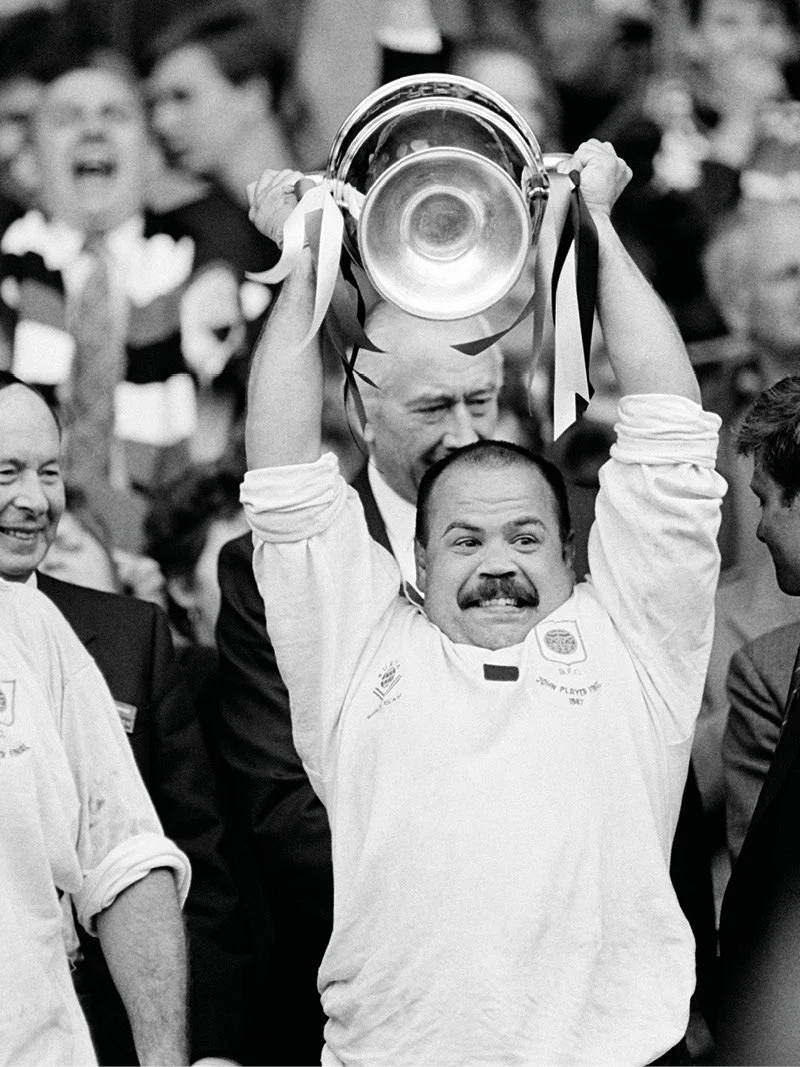
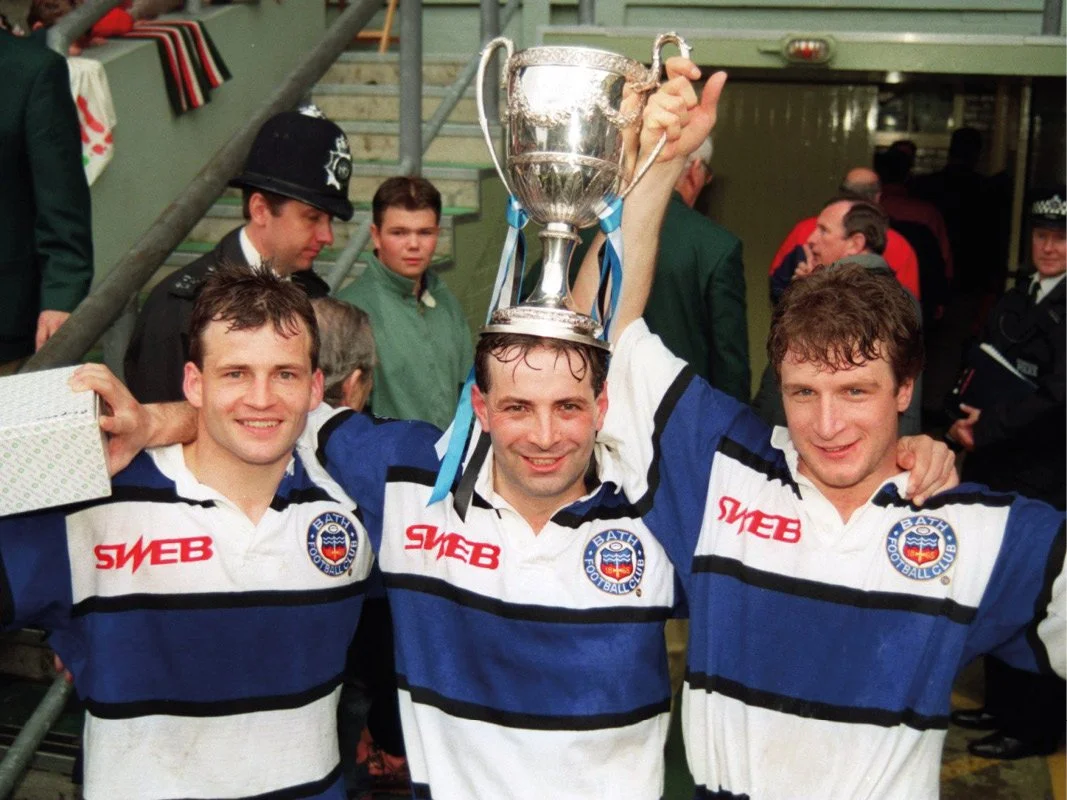
The maiden final win, was followed by three more on the bounce: London Welsh (24-15), Wasps (25-17) and Wasps (19-12). “I remember the third time we won the cup, against Wasps, and I genuinely remember as we walked off the pitch, thinking, ‘no one will ever do this, win three cups, again’, and a year later we won it again.”
Getty Images
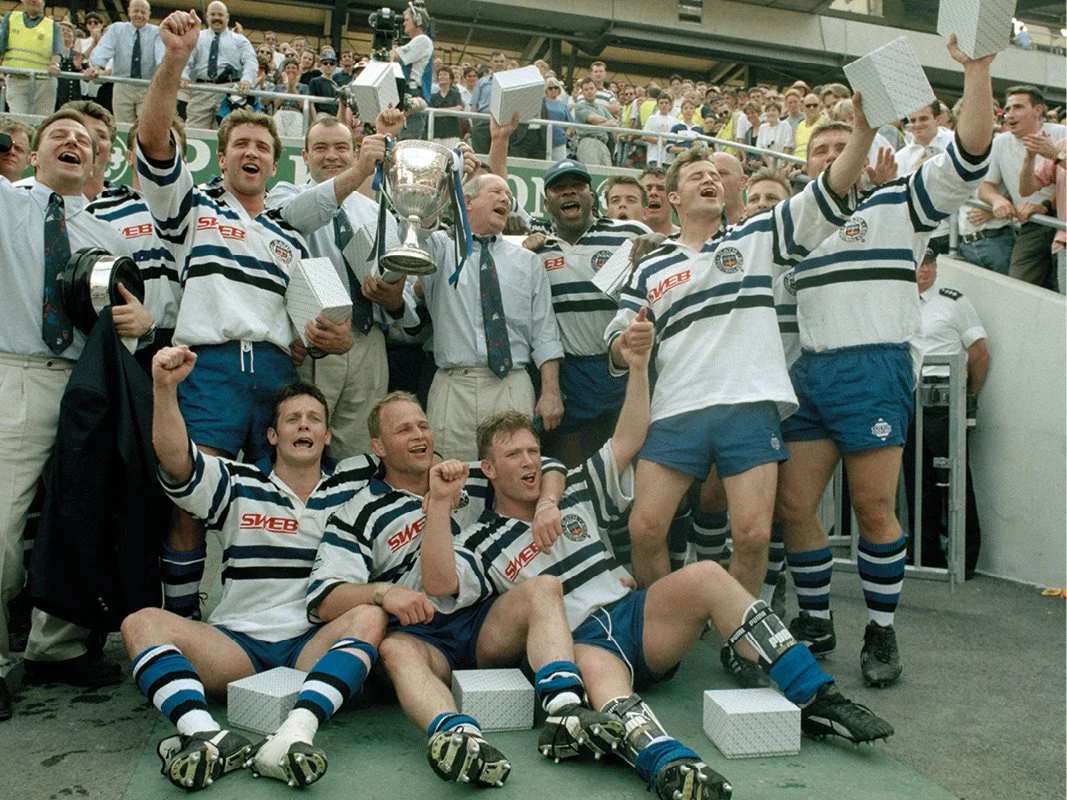
The crowds increased, adding almost 10,000 fans from that first final to the fourth, Bath fans were getting used to success. “It was such an unbelievable time to be playing rugby for Bath,” says David. “Fans would be planning days out at Twickenham before a ball had been kicked at the start of the season, it would be ‘last one out of Bath turn the lights out’ as the blue, black and white army made their way up to Twickenham, it was phenomenal.
“We used to do those bus tours around the city [when we won],” continues David, “and literally thousands would turn up to watch. It took your breath away.”
Stuart Barnes, who’d switched from Bristol to their vanquishers Bath by the time of the third final, had previously pointed to the players’ bond with their fans as key to their success. “We used to drink together [with the fans], at the Pulteney Arms, and the cup would always turn up at Lansdown Cricket Club on the Sunday after the final,” says David. “All players felt that supporters did play a big role in the overall success of the club.
“There are two key things in my opinion,” says David of Bath’s success. “One is recruitment, because every single year there was nothing drastic, but one or two players would come in, one or two eased out, and you’d just hope you weren’t one of those eased out. It meant you’d have a young Simon Halliday come in from Oxford University, or David Sole and Richard Hill from Exeter, all very good players.
“You still had Bath players, born and bred, but that recruitment made a difference.
“The other thing,” continues David, “was that you’d focus on one skill for part of every single session for an entire season: twenty minutes on one single facet of the game, such as support play, just so it was really ingrained in everyone.”
Four years, four cup wins changed everything. “It started the legacy of Bath,” says David “I put an awful lot of that success down to Jack Rowell: we had good players, and a fantastic environment, and before then we were the poor relation to Bristol and Gloucester. I used to say when the leagues were first formed, while we quite rightly deserved to be in the top league, if you looked at our overall history, the real place was probably mid-table in the second division. But those good times, there had never been anything quite like that; what Jack built was phenomenal. And because of that, all these years later, a local guy [Bruce Craig] sold his company, and bought the club to try and do it again. He did say it’s taken a lot longer to build something significant than he thought, but it’s absolutely worth it…”
Bath didn’t do cup upsets in that era, but one winter in 1985 – as regular readers of Rugby Journal would know – after consecutive games were hit by the weather, they sought out a ‘friendly’ against the only west country opposition whose pitch wasn’t frozen. “We took the entire first team squad down to Brixham, only myself and I think one other didn’t play, and they beat us [9-6].
“We got to the final of the cup that year and before the final the captain used to read out the telegrams we’d received and there was one from Brixham wishing us all the best because they wanted to be the team that had beaten the winners of the John Player Cup! We duly obliged.”
Getty Images
Bath had an intensity unlike any other side of the era. “Before each game our forwards would go into the bath or shower area and have a talk, while us backs sat around and chatted in the changing room,” explains David. “We could judge the intensity of the match ahead by counting how many times they used the f-word, and the absolute record was not for a final but for a quarter-final against Leicester: 53 times they managed to get that word in and they were only talking for three minutes. They always fired themselves up for Leicester.”
The fifth year didn’t happen. “We played Moseley and lost 4-3 [in the quarter-final],” says David. “This was another case of us still not winning the game even if we were still playing now. We even put the ball down on the five-yard line thinking it was the try line. I had a kick to win the game, and that was only because nobody else was kicking well. Stuart Barnes had taken some and it hadn’t worked out, Phil Cue had a go and it didn’t work out, and I was the third person. It was literally the last kick of the game, and Spurrell threw the ball at me, and said, ‘put it over’, ‘no problem Rog’… It was 35 metres out, just slightly to the right, and I struck a pearly, it was going from boot to middle of posts, then fifteen metres out, it just turned left, and hit the left-hand upright. We were never destined to win that one. We’d won four times, and played two or three rounds and won every game, twenty-odd wins – and one draw against Orrell – and this was it.
“The travel agent had to rearrange the trips for those 40,000 people that were going to the final from Bath and that changing room… people say you only ever remember one or two victories, but you absolutely remember defeats and that changing room after losing wasn’t a pleasant place to be. God, I remember sitting there in silence, until after about ten minutes Jerry Guscott stood up and said, ‘Well, there’s fuck all we can do about it, so let’s get on it’.”
The cup had become big news, front and back pages, cities emptyingwhen their club reached Twickenham. Prize money continued to rise: in 1988 the pot was £136,625, three years later it was £1m over three years, with a renewed deal with Pilkington, put in place after a successful Rugby World Cup. Rugby was changing.
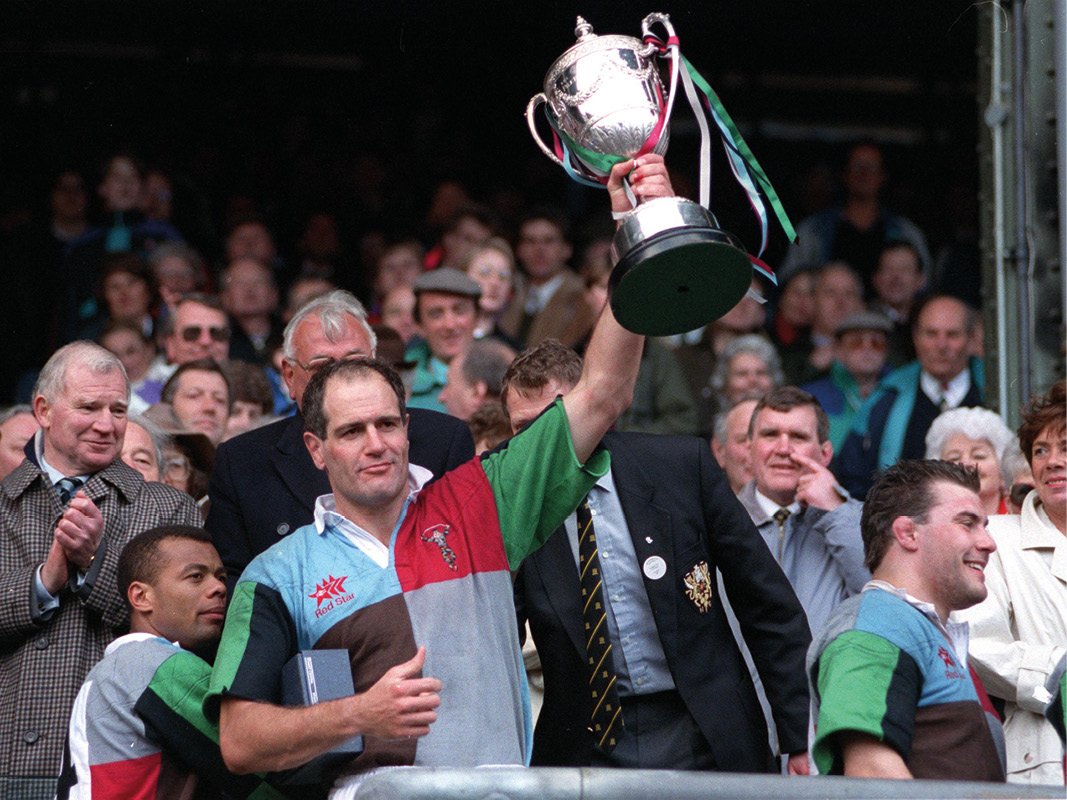
World records fell too: the 59,300 fans at the 1989 Leicester v Bath final – which both clubs had asked to be counted as a league game too, to reduce fixture congestion – was the biggest club game ever (although a Japanese game did soon topple it with 66k). Bath won that 10-6, then made it a double the year after with a 48-6 drubbing of Gloucester. They allowed Harlequins a win the following year, before returning to the winners’ podium in 1992, when Stuart Barnes popped up in extra time to secure a 15-12 win. Leicester then took the cup in 1993, before a second run of three Bath triumphs began.
Bath wouldn’t even be beaten on attendance, breaking the record again in 1994 as 68,000 watched them defeat Leicester 21-9. This time Jon Callard’s boot helped them to victory with three penalties and a conversion to supplement a try apiece from Tony Swift and Mike Catt.
In 1995 they beat Wasps 36-16, then drew another record crowd (75,000) to Twickenham as they defeated Leicester 16-15 in 1996.
Callard had been part of the squad since the 1990 demolition of Gloucester. “I was very fortunate to have a good [rugby] upbringing at Newport,” explains Jon. “But going to Bath was just a complete eye opener. No disrespect to Newport, they had a couple of coaches, but you go to Bath and they’ve got forwards, backs, fitness guru Tom Hudson, sports psychologist, and the training was ahead of its time, so detailed, so thorough, so planned, all aspects of game covered. Moving to Bath, you had such an array of stars, wow, you either pull your socks up, or you’re going nowhere.
Getty Images
“Everywhere you looked it was internationals galore,” he says. “Richard Hill, Nigel Redman, Gareth Chilcott, this personality you saw on TV, then Tony Swift, these guys playing for England, Graham Dawe, Richard Lee, Damian Cronin, Andy Robinson, John Hall … If John was a player today, you’re talking about a £1m player, he was phenomenal, his strength, aggression, a hard man. Then there was Halliday – one of the first outside centres to really take people on, and the pace they had staggered me, it was the same through all the side, not just Guscott, everyone had pace, it was striking.”
Cup games meant preparing like pros. “We’d always stay in a hotel the night before the game even if we were just going to Bristol,” says Jon. “It just meant we could get together and have a glass of wine because we weren’t together all the time – it was just this group of different people: doctors, accountants, marketing managers, school teachers, chauffeur, sharing stories.”
As Bath’s dominance continued, naturally rivals started to look at their methods. “More people got wind of what Bath were doing,” explains Jon. “We were ahead of our time in training and people cottoned on to that, and the finals got more intense.
“They’d get built up more [by the media], it didn’t just get a couple of column inches the day before, it was building up for two weeks before, there was a lot more scrutiny, a lot more focus. The day after [the match] filled pages, and Monday papers too… there was a definite change in the wind.”
Even the most golden eras have to come to an end. “Professionalism came in, and it’s sad really,” says Jon, sorry to see the romance of cup ties against lower-division clubs gradually disappear. “Gosh, we had some scares along the way. We played Wakefield away [1996, 12-16], they were a good side, and we won by the skin of our teeth. That came down to their hooker, delaying a throw in, giving away a free-kick, we tapped and went in under the post in front of a Yorkshire crowd baying for our blood. That’s what the cup could do, you weren’t just staying in your cocoon. You might be going to the Forest of Dean as Saracens did when they had to play Lydney and had a right going over by the locals [eventually winning 0-40], but the cup brought everybody out. We can never go back: health and safety (the gap between amateurs and professionals), you can’t have it nowadays.”
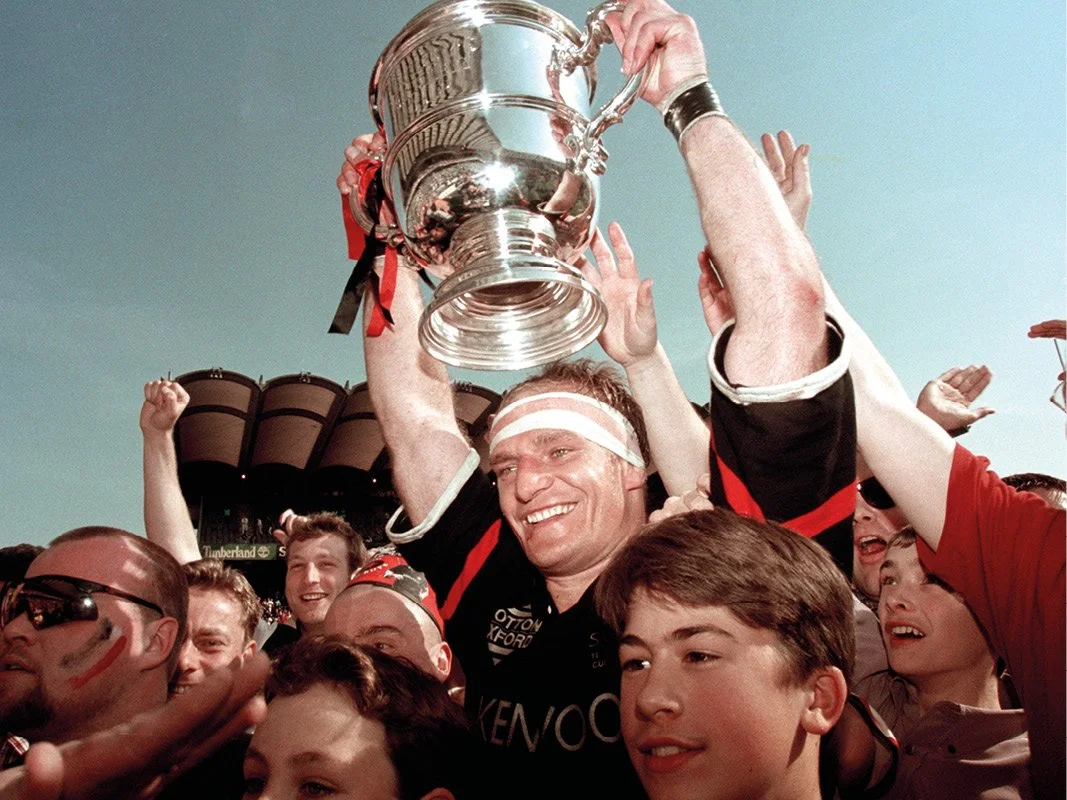
Bath’s descent from the top was almost aligned with the decline of the cup. “I felt professionalism was the moment that dragged Bath back,” says Jon. “The baton was handed over to Leicester and Wasps, they bounced into professionalism better than Bath. Because, even though Bath were the first [English] European winners [taking the 1998 Heineken Cup, with a 19–18 win over Brive], we were struggling domestically, because I felt a lot of our good squad players got ripped apart, the cheque book came in, guys that were fantastic squad players were being offered lots of money to go elsewhere and took it.”
Getty Images
The side that won the European Cup was an ageing one, featuring the likes of Ieuan Evans, Nigel Redman, Phil de Glanville, Jeremy Guscott and Callard. “It was ageing, but we had experience, and in a one-off cup final, we could do the business…”
Playing time for the elite was another factor in both Bath’s and the cup’s decline. “I remember losing to Richmond in the cup [17-29 aet],” says Jon, “then the week after we had to go to Bordeaux to play Brive in the Heineken Cup final, you can’t win them all.”
Bath’s last domestic success had come in the 1996 final, fittingly against Leicester in an ill-tempered 16-15 win in front of 75,000. “The infamy of that Leicester cup final with Neil Back [who famously pushed the referee]. They scored a try from our lineout, we got a penalty try to win it, but we were shocking.
“One of the things with Bath was that it was not how bad you were doing, it was how well you could find a way to win. There was a belief that you got, the longer you were there, that you got more comfortable with not panicking when you were losing. If they scored, it was always, ‘don’t worry we’ll get that back’. There were harsh words, it was brutal, but it bred winners.”
Just as the cup had started eras, it also signalled the end of eras. Even for Bath. When Leicester crushed them 39-28 at the Rec in the fifth round of the 1997 tournament – before going on to take the cup with a 9-3 win over Sale – the most famous club of them all were in turmoil, and club legend John Hall (who had won five cups as a player) was removed from his role as director of rugby. Bath, even though they were still to become European champions, were no longer feared, the era was over.
Like any true cup competition, unless you’re a Bath fan, the best partwasn’t necessarily the eras of dominance, it was the days in the sun for the small clubs. The upsets. Such as when Orrell beat Harlequins 25-7 at Edge Hall Road, leading the losing captain Mike Mason to famously lament his side, ‘were beaten by a (bloody) lay-by off the M6’. That win signalled a change in times. The Guardian’s David Irvine wrote: ‘Orrell are sweeping like a breath of fresh air through English rugby. For too long the aristocrats of the club game pottered along complacently – snug behind the same old fixtures, the same predictable opponents, year in, year out – until now, when this maverick Lancashire side, who respect neither reputations nor records, have squeezed through the keyhole of knockout competition, and exposed the dull, stereotyped first-class game for what it is!’
Some upsets didn’t quite materialise, such as when Southend hosted Gloucester and gave them a scare, before losing 6-12. Gloucester needed two late tries to secure victory, with Southend leading 6-0 for most of the match.
Or when Aspatria, in horrendous conditions, and with their brass band sinking into the mud as they played, almost turned over Rob Andrew’s Wasps, losing 6-13 in front of a home crowd of thousands. The cup is rich in history for sides like Aspatria, who the season before had taken the scalp of Moseley (6-3), only to lose, for the first time, to Wasps 39-7.
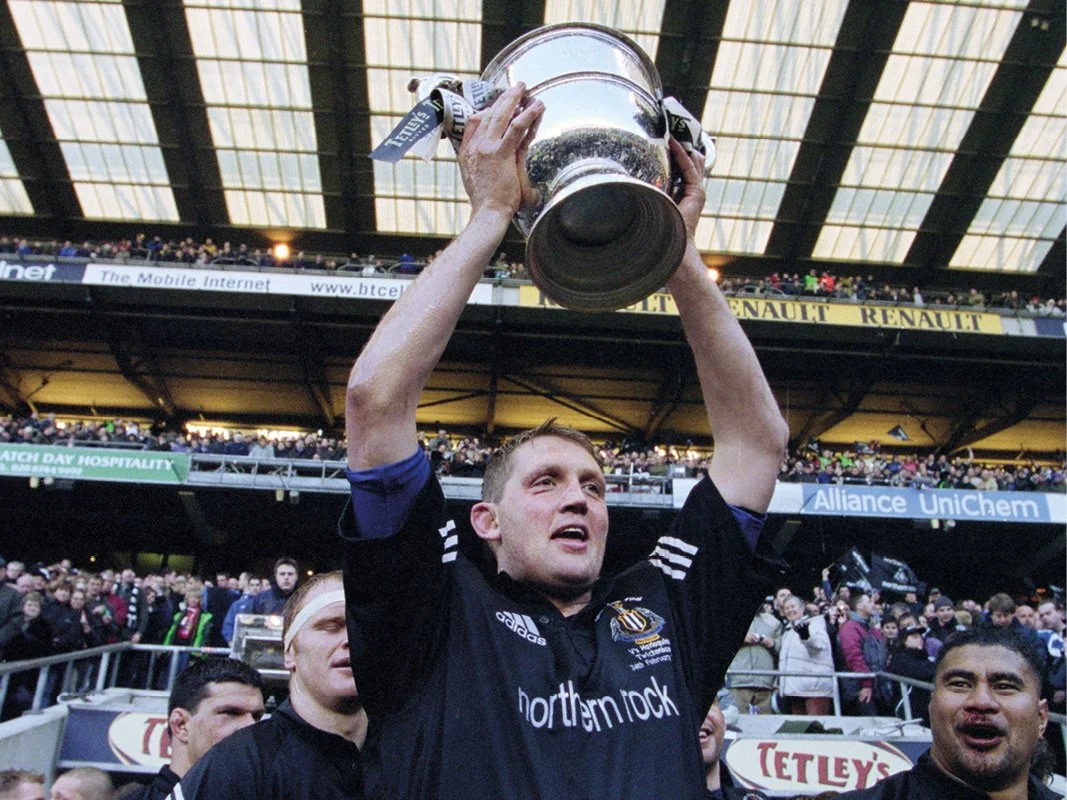
Right until the very end of its status as a nationwide competition, the cup delivered upsets, the final, proper one, coming in 2004 when Pertemps Bees, aka Birmingham-Solihull, of Division One (today’s Champ) overcame Warren Gatland’s reigning English champions Wasps 24-28 at their Adams Park home.
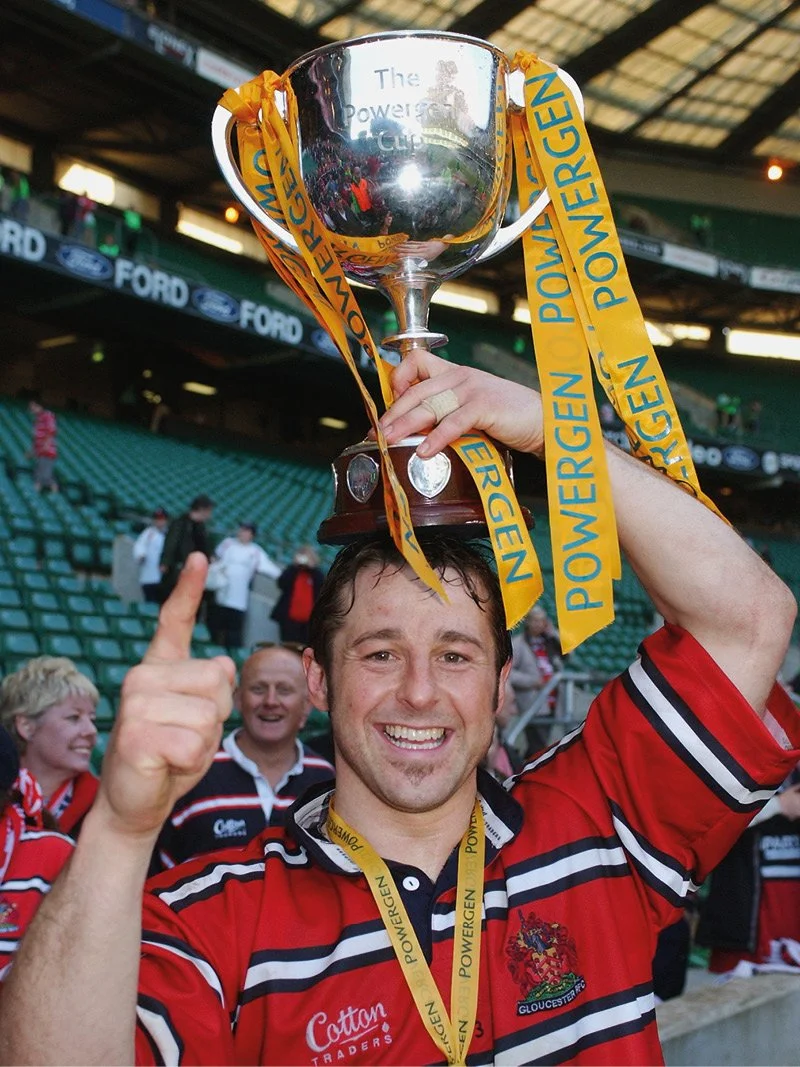
From Bath’s final win in 1996 until the last all-English knockout cup in 2005, the winners were varied. With professionalism taking root in the game, it was reflected in the sides that triumphed in the knockout competition. A Saracens side laden with galacticos such as Francois Pienaar beat Wasps 48-18 at Twickenham in 1998, before the defeated finalists then took hold of the domestic game with back-to-back wins in ’99 and ’00. Then it was the turn of Newcastle in 2001 (and again in ’04), and London Irish, before Gloucester did their thing with a 2003 win over Northampton, over two decades since their last, and three since their first.
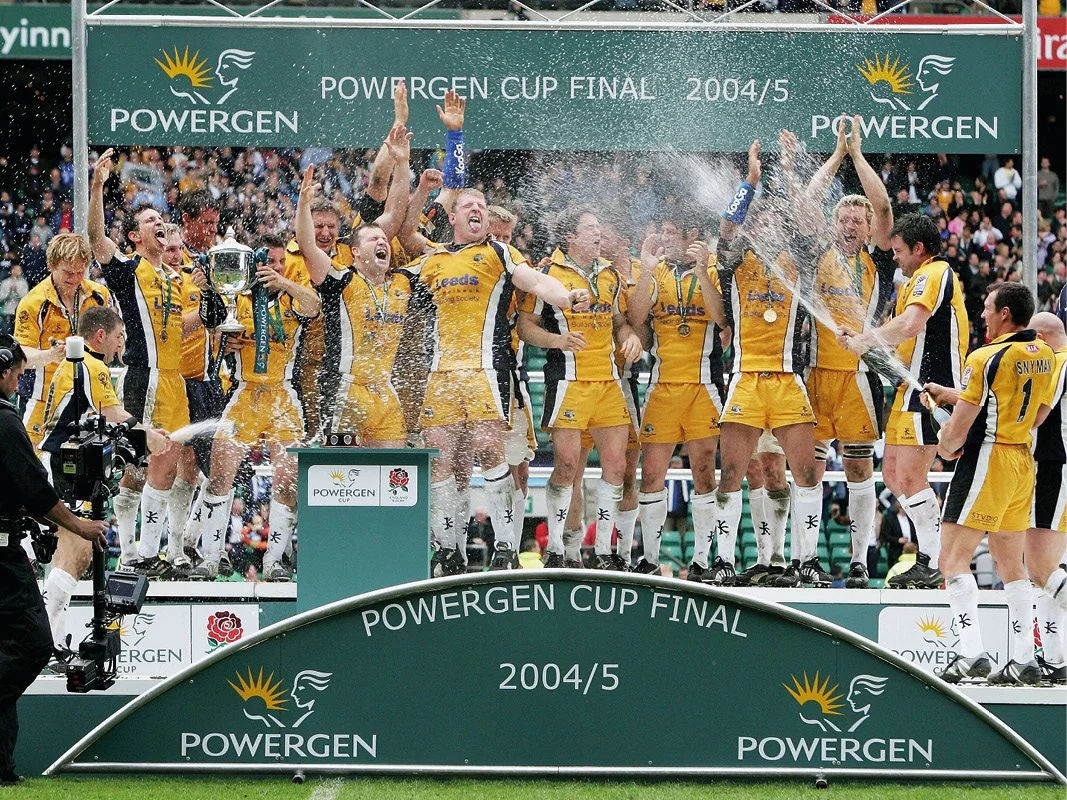
So, the last four English cup finals were won by four different sides with Leeds Tykes perhaps giving the cup competition a fitting farewell in 2005, getting a 20-12 win over a Bath side that, while a shadow of its former self, still gave the fans one more Twickenham cup day, with much of the 60,300 crowd wearing blue, black and white.
An Anglo-Welsh era, a closed shop featuring the English Premiership clubs and the four Welsh regions began strongly. London Wasps beat a strong Scarlets 26-10 at Twickenham with 57,212 in attendance; swiftly followed by Leicester and Ospreys playing a brace of finals, and sharing the spoils – a 41-35 win for the English in 2007, a 23-6 win for the Ospreys in 2008 – while also bringing in the fans, 43,312 and 65,756 respectively.
Even in its final year as a competition the clubs sort-of cared about, the cup would deliver, with a 50-12 romp for Xavier Rush’s Cardiff over a strong Gloucester side, not to mention an attendance not to be sniffed at of 54,899. Then came the definitive end of Twickenham’s domestic cup days: the final was moved to Sixways, capacity 12,067, and a period of questionable interest began, before the Welsh clubs left in 2018, and the competition fell into disrepair.
A number of reasons were behind the cup changing to become effectively an A-league for developing players: workload of the elite players; the media, and fans, switching attention to the burgeoning Premiership and Heineken Cup; and because of the latter, sponsors not having the spend to make it worthwhile for the clubs to put out their big guns.
Such is the lack of clarity on where a cup fits in and what it should look like, in this 2025-26 campaign we’re back to Prem clubs only, after a couple of more interesting seasons with Champ clubs involved.
Sadly, for the game, cup competitions are struggling across the board. The Papa John’s Cup was intended to give grassroots clubs a route to Twickenham every year, but it was damaged irreparably by walkovers (96 out of 216). Terry Burwell, who not only played in the cup for Leicester, but has also been involved in the knockout cup administration for so long – he may well have been on the Staff and Gentleman Cadets of Royal Military Academy Woolwich’s sub-committee – believes the lack of interest in cups at the top level has now spread all the way down the pyramid. “In the community game, when we looked at the future competition structure, we asked players specifically if they wanted league and cup fixtures, and there was a strong consensus they wanted a variety of competition,” says Terry. “The reality with the Papa John’s Cup was that the players wanted anything but cup competitions, with significant problems caused with walkovers. And so we removed the cup from regional leagues, and introduced play-offs.
Getty Images
“Then we asked the clubs lower down, at county level and below, if they wanted all their cup fixtures at the end of the season, or some during, then maybe a semi and final at end of season – we also gave the option of no cup. They said yes [to keeping the cups], but already the number of walkovers from the early rounds has been quite shocking, so they clearly don’t want a cup either.
“League rugby is all-consuming now,” continues Terry. “And we’ve got some decisions to make about whether we keep shoehorning the cup into a season. Is it what players want? We know we don’t want more league games, because of player availability and weather, so it’s probably better served to have a fixture list with reasonable breaks, giving time for players to regroup.
“I think,” he admits, “even as someone who enjoyed the cup with Leicester, and Newbury, we’re probably seeing the end of an era. It’s a great shame, clearly cup rugby was special. The cup was the foundation of competition in English rugby.
“There was something in a result in a day that made it unique, whereas with a league programme, you could go down and lose to a side, but you’re still sixth, or know if you win the next week, you’re back up to fourth, you get another chance. Cup rugby doesn’t do that.
“The cup created an element of jeopardy, and it’s a shame we’re going to miss that, but times move on. We’ll probably have one last throw of the dice with national cup competitions, and the counties will continue to find a way.”
Nonetheless, the cup has earned its place as an important part of English rugby history. “The cup was a catalyst for change from the amateur era,” says Terry. “We had the Anglo-Welsh merit table, but structurally there was no competitive programme, so the cup served the purpose of being the birth of the competitive era, and now they’ve come out the other side of the tunnel, because, from a commercial perspective, you get greater engagement for a whole season.
“Competitions have to evolve,” he says. “And, now we’ve got another cup in the Nations Cup, it’s quite simple in its design, it’s going to have a North v South, Ryder Cup challenge, so it’ll be interesting what happens with that.
“Cups were a big day,” concludes Terry. “So, it’s very sad, they were the catalyst of change from amateur to professional era, the driver of professionalism but, now, ironically, professionalism has been the catalyst in the demise of cup competition, so it’s gone full circle.”
And, ironically, so have Bath. A legacy that began with winning the only cup on offer forty years ago, has now rediscovered its rhythm, winning silverware once again – European and league titles – and it’s the same name on the cup, it’s just a different cup(s).
Story by Alex Mead
Pictures by The World Rugby Museum & Getty Images
This extract was taken from issue 32 of Rugby.
To order the print journal, click here.